Today was Buy Socks at JC Penney Day. I celebrated. Did you?
This post has nothing to do with writing. Merely an odd happenstance I felt like sharing.
JC Penney recently mailed out coupons for $10 off any purchase of $10 or more, good from today through May something. My older child has been in dire need of new socks, but we haven’t had a chance to go shopping for them until today. Coupon in hand, off we went to purchase foot coverage.
She made her selections and we lined up at the cash register behind three other people. All holding their $10 coupon and buying socks. And I mean nothing but socks. Not socks and a swimsuit, not socks and a necktie, not socks and some slacks, only socks. Exactly like us.
I can’t decide if it was a function of the weather, which has taken a turn for the wet and chilly this weekend, or perhaps a sign of the economic times. Can people only afford socks when they have a $10 coupon? Have the tight times caused people to be practical with found money? Or it could have been sheer coincidence. But somehow I find myself wanting an explanation. What if it were intended to be a sign to me that I’d found my peeps and I totally missed it, not even striking up a conversation with anyone? Okay, I’m sure it was coincidence.
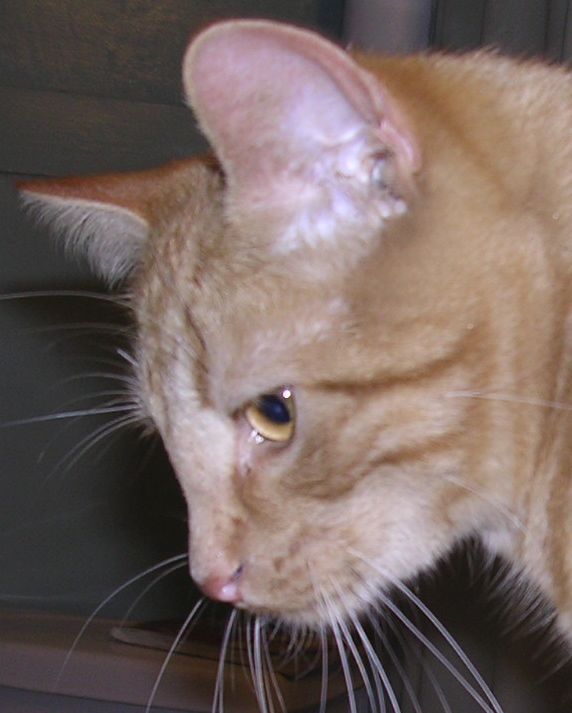
I say obligatory because so many poets write about cats. My family’s cat, Dude, really was a cat in a million, and I loved him unreasonably.
So far, I’ve managed to write a poem every day this April. This is one of them.
Dude
Hang around cat
Amber eyes surrounded by
Orange on orange
All attached to a companionable
Nonchalance
Not a lap cat
Not a fighting cat
Not a recluse cat
But a hang around cat
If you’d been human, you’d always
Have had a light for the buddy’s
Cigarette and a six pack of beer to share
But no advice
Only a thereness for everyone
To come to depend upon
As the humans in your household did
With your catness
Some part of your thereness is still here
Even if you aren’t
I wrote this essay a few years ago. It has received more “we almost published this” letters than any other piece of writing I’ve produced, yet it never makes the final cut. So why not put it here?
Good test scores? A lifetime supply of cookies for you!
**
Human beings are incapable of playing in the rain. I learned this when I worked for the local public school district. One of my duties in the Title I office involved processing the tests given to children as part of their preschool screening. In the section used to determine a child’s problem solving ability, a question asked, “What do you do when it rains?”
One boy answered, “You can play in the rain if it’s warm and there’s no lightning.” He was marked wrong. Apparently the creators of the test and the answer key knew something I didn’t. I thought people possessed the ability to frolic in falling water. I was also under the mistaken impression that we humans could stomp in puddles, but the kids who mentioned this activity were considered equally wrong. The only things we can do when it rains are: go inside, use an umbrella, or put on a raincoat. According to the test makers anyway.
I’m not criticizing the Title I program. It’s a good thing. It helps kids who need extra assistance prepare for kindergarten, and provides individualized instruction to children who are struggling with reading. The Title I teachers and administrators I saw in my stint as an office grunt were by and large hard working, empathetic and dedicated. But they worked within the public schools, and as far as I know, no part of the public school system escapes the scourge of required standardized testing.
This isn’t a new development, of course. During my own school days, in fourth grade to be exact, I was identified as gifted and placed in a special program. In what area did my gifts lie? Not visual arts; I was about average there. Certainly not music; to this day I can’t carry a tune. My social skills were mediocre at best, so I wasn’t being recognized for my interpersonal abilities. I could do math in my head, and I loved to read. But my real, true gift, my greatest ability, was test taking. I intuitively grasped the formula for multiple-choice tests and I had a talent for figuring out what authority figures liked to hear in the way of answers. Throughout the years of my formal education, I received a lot of praise for my exam marks.
How have I applied this skill in my adult life? I haven’t. I’ve never found an employer willing to hire me to take tests. I don’t field requests to perform the Stanford Binet at parties. Nobody knows or cares what my SAT scores were. My husband didn’t bother to find out before he asked me to marry him. My children don’t care; they just want to know what’s for dinner. All of those numbers everyone made such a big deal about back then turned out to be the most irrelevant facts of my life.
As much emphasis as test scores received when I was in school, things are worse for my own kids. For their generation, it begins when they’re toddlers. Both of my children were enrolled in Parents as Teachers, an early childhood program, free to families, in which a parent educator comes to the home roughly once a month, does educational activities with your child, and gives you information about child development. Like Title I, it’s a good program with many benefits. Then there’s the testing.
My kids, both at the age of two, participated in the Denver II screening, given to check their progress on various developmental milestones. My daughter and son both proved the maxim that tests can be standardized, but children can’t. One of the skills the children were asked to exhibit was block stacking. My daughter, as a toddler, adored building toys. She performed brilliantly on tower making. The problems began when the blocks were put away so she could move on to demonstrating her social and verbal acuity. The parent educator may have thought they were done playing with blocks, but the examinee disagreed. For the remainder of the session, every question posed to my daughter was met with a request for more block play. Finally, the examiner gave up asking her anything.
As my little girl sat happily constructing walls, the parent educator pondered how to “score” her. I looked over the questions and pointed out that my daughter had demonstrated all the listed skills during previous visits. According to the rules, though, she couldn’t be given credit for them if she didn’t do them during the test. On the other hand, the examiner couldn’t well write down that my child was incapable of things she had been observed to do. The parent educator eventually wrote the word “refused” on the lines where the child’s answers were supposed to be recorded. An Alford Plea of sorts, I suppose.
When my son did the same screening three years later, he willingly answered every question. He loved to talk; it was his favorite activity at the time. But he tended to give nonconformist answers. When asked to supply the name of a friend, he said, “Grace (his sister) is my most friend.” Wrong. He was supposed to have given a name from outside the family. In the world of the Denver II, siblings can’t be friends. As his mother, I felt he couldn’t have given a more right answer.
At the time I found it amusing and even endearing, the way my children wouldn’t be boxed in by these silly tests. I stopped laughing when I discovered the scores were to be included in their school records and the numbers used by people who had never even met my children to make decisions about their educations and lives.
This is what makes me all prickly about standardized exams. They don’t produce insight; they produce numbers, which are taken completely out of any context, and then used to define a child. I never met the Title I child who liked playing in the warm rain, but his response gave me the impression of a joyful little boy who also had a level head on his shoulders. Not only did he refuse to allow the weather to spoil his fun, he possessed enough wisdom to evaluate when it was safe to be outside and when it wasn’t. That made him an A#1 problem solver in my book. Unfortunately, what went into his school record likely reflected a different view; perhaps of a boy who was only a three in problem solving, not as clever as those fives. We can’t expect as much from him.
Similarly, my son’s “score” was skewed. In our family, we regard each other as friends. I guess the folks who created the developmental screening didn’t get along so well with their own relations. Too bad they’re the ones who get to say which is the right answer when a difference of opinion arises. Where I saw a sweet, big-hearted boy who adored his sister, the number assigned to him declared he wasn’t quite up to speed with his social awareness, and subsequently he entered school already labeled as a bit deficient.
Then there’s my daughter, who exhibited all the skills they were looking for every day of her life except for test day, when she had something else on her mind. Even if everyone agreed on which questions and answers were necessary and right (a big stretch), a test score still only reflects what the child does during one small portion of one day, ignoring whatever accomplishments she demonstrates the entire rest of the year.
My children have been blessed so far with wonderful teachers, ones who do look beyond the numbers. My daughter’s second grade teacher realized that reading level and emotional maturity are two very different things. Though my daughter could read most of the books in the school, she wasn’t ready for the themes in some of them. The teacher made an extra effort to find books for her that met her needs on all levels. In first grade, my son rarely completed any work assignment. His teacher, drawing on her years of experience, recognized his painfully slow work habits as a product of perfectionism. She had the wisdom to see he didn’t need extra instruction in the subjects at hand, but did need encouragement to take risks. These are the sorts of insights that are at the heart of effective teaching and can never be gained from penciled-in bubbles on an answer sheet.
Yet, thanks in large part to the federal government’s No Child Left Behind Act, these terrific educators are able to spend less and less time educating. One day, looking at my daughter’s heavy homework load, I asked, “If you’re doing all this work at home, what is it you’re doing with your class time?”
“Taking tests,” she said with a world-weary sigh.
A number of philosophers have written about the human tendency to confuse the symbol with the thing it symbolizes. It seems to me this has happened with test scores. They’ve been transformed from a symbol of what students are pursuing – education – into the thing pursued. In the interest of raising scores, students at West Blvd Elementary School, in Columbia, Missouri, are now be required to spend longer days, and more of them, in the classroom than other students in the Columbia Public Schools. The district’s budget is so tight that some teacher positions had to be eliminated; yet money was found to create a new administrative position, “Director of Research, Assessment and Accountability.” A testing czar, in other words.
Posted on the Columbia Public Schools web site is the district’s Assessment Plan, all 49 pages of it. Two pages are devoted to “motivating students to do well on state and district-wide assessments.” Techniques mentioned include treats as rewards (Tootsie Rolls are listed by name), raffles, and motivational assemblies. Another two pages are devoted to test-taking strategies. One of the strategies for multiple choice tests is: Choose a middle answer (B, C, or D) versus a first or last choice when a guess is necessary. This isn’t unique to one school district; it’s a standard tactic for multiple-choice tests. It’s also an admission that a high test score doesn’t necessarily reflect mastery of a particular subject. Mastery of how to work the system maybe.
There are better ways to assess the areas in which a child is doing well and in which they need more help. Some private schools and home school families have pupils build a portfolio throughout the year to provide an overview of what they have learned and accomplished. Daily observations and common sense go a long way as well. I don’t need a test to tell me if my kids can manage fractions. They cook with me in the kitchen and can easily double recipe ingredients from a quarter to a half-cup, from 3/4 to 1 1/2 teaspoons. My daughter has taken several sessions of private weaving lessons with not a single test of any kind. But anyone looking at the pieces she turned out with each successive class could see how much she was learning and improving.
So why do we parents, teachers and school administrators keep participating in what so many of us see as a deeply flawed and harmful practice? Though it makes me cringe to admit it, the honest answer for me is fear. According to federal and state mandates, any school with less than 95% participation gets in trouble. So do the schools where students don’t produce high enough scores. I’ve considered boycotting the MAP (Missouri Assessment Program) by keeping my kids home on testing days. But then I’ll think, “Do I really want our school’s year extended? Do I want to feel responsible if teachers lose their jobs?” No wonder the administration is almost frantic to make sure children show up to take the test. And fill in the correct bubbles.
Another problem with moving away from mass standardized testing toward a more informative and helpful system of assessment is that it would require teachers to pay increased individual attention to each student, which would mean smaller classes, which would mean a need for more money. I’m convinced the resources are there; it’s just that we as a society would have to make a major commitment to changing our priorities. The words from the classic bumper sticker come to mind: It will be a great day when our schools get all the money they need and the air force has to hold a bake sale to buy a bomber. A tall order, but maybe we don’t have to try to accomplish it all at once; we can keep it as an eventual goal.
In fact, simply eliminating standardized testing would be a good start on freeing up material and human resources to be used for better purposes. My local school district’s budget for the past year included more than $170,000 just for testing materials. I don’t know what salary is paid to the new testing administrator. But it looks to me like eliminating the testing budget plus the new administrative position could provide enough money for at least a few more teachers.
And what can parents do to make this start happening? Realistically, many of us struggle just to keep up with the laundry and grocery shopping, and don’t feel equal to the task of reforming an entire culture. For some the answer is private school or homeschooling. For others, those aren’t viable options. Personally, all I know to do is keep talking every chance I get, and encouraging others to do the same. Maybe someday someone will listen.
In the meantime, I do what I can to educate my own children about the realities of standardized testing. I especially like to tell them true stories about “problem” students, such as Thomas Edison, Albert Einstein, and M.C. Escher (who famously flunked out of school because his test scores were too low.) When we talk about the ‘gifted” program and the fact that the school district deems only 2% of students worthy of an enriching educational experience, I give my kids a story problem, “If two percent of students have enrichment provided by the schools, then what percentage of pupils will have to go get what they need for themselves, and which group is learning more about resourcefulness?” And when we get tired of discussing schools and testing, we all go out to play in the rain. Some days I feel like that’s the best thing I can do for my children.
And the fates laughed. I knew that as soon as I made a plan, the universe would rebel.
“You have five hours scheduled into your week for writing? How about if I send you a rotator cuff injury? What if you had to spend your time on doctor’s appointments, special exercises and ice packs, all while moving at 75% your usual speed? What then, hmmm? Think you can handle it? How about if I pile on two unexpected snow days out of school for your children? Think you’ll do those five hours now?”
And I reply: Ohhhmmmmmmm. I will not wait for my normal life before I start writing. Ohhhmmmmmmm. This is normal life; I will write anyway.
But I didn’t make my five hours the first week. My writing log tells me I clocked a total of 4.1 hours. Looks like I have some make-up to do in the next seven days.
I’d like to announce that I’ve already made progress on my writing-related goals for 2010 by improving my blog, however slightly. Look over to the right. I finally have a “follow” button and have also add an RSS feed option.
My writing goals for the coming year and beyond can be summed up under one umbrella resolution: Treat my writing more like a job. This means I will establish regular office hours and I can’t take off from work willy-nilly. If I need to miss work, then I’ll need to make up the hours. With the demands of my “real” job, my old house, my two children, my pets, etc. I find it all too easy to sacrifice my writing time to dentists and veterinarians and school staff who need volunteers to help with a project, not to mention all the time I spend at the hardware store. Since my regular job is part-time, in theory I have a couple of days a week when the kids are in school that I should be able to devote to my writing. In reality, those are the days I end up doing all of my appointments and errands. Then I try to fit in the writing around all the rest. A lot of times, the writing doesn’t happen. I aim to change this.
I’ve broken down my general intention into smaller, specific goals. From past experience I’ve learned I need to keep my goals limited to things I can control. So my list doesn’t include the goal of having someone else publish a piece of my writing, but it does include how many pieces of writing I want to finish and send out during the year. The hope is to have them published, of course, but since I can only control my end of the process, that’s where I need to focus.
My list of writing goals:
Set regular office hours and stick to them, at least five hours per week.
Finish the rewrite on my novel and offer it for consideration to at least ten outlets (publishers and/or agents) before the end of the year, unless someone accepts it before I reach ten.
Write at least four short stories and send them out into the world. I decided on four for the year, because I have four ideas floating in my head right now.
I currently have a book of poetry entered in a contest. If I don’t win that, I will offer the manuscript for consideration to at least ten other outlets or until it is accepted for publication, whichever comes first.
I will not let a month end without sending out at least one item.
I’ll update my blog at least three times each month. I figure once every ten days or so is a minimum. I will learn more about the nifty features of my blog and attempt to improve it.
Shortly after I posted the poem about accidentally mowing a snake into pieces (the headless fellow in the grass), I was given a chance to make some amends to the world of snakes. My cat, of whom I never would have expected this, caught a snake and brought it to me.
The reason I wouldn’t have expected it is because this particular cat has a deep and abiding love for the indoors. About once a day, she stands at the door mewing desperately to be let out. Once the door is open, she ventures as far as the edge of the porch and has been known to remain there for as long as 90 seconds before spiraling into regret over the terrible mistake she’s made. Then she mews desperately at the other side of the door until someone lets her back in. Nobody would peg her as a snake catcher.
I didn’t count on her finding a snake in our basement. But the other day as I sat in the living room, typing away on my laptop, she came trotting up from the basement with something long and skinny dangling from her mouth. When she dropped it in front of me, it slithered. It slithered with amazing speed. She pounced, it struck at her, she picked it up again, it writhed away again, she batted at it and I realized intervention was needed.
After an untaped, never to be seen episode of Funniest Home Videos, involving me, the cat, the snake, lots of yelling, hissing, slithering, stalking, running, tripping over chairs, and ultimately, the use of a Rubbermaid container, I managed to set the snake free outside. Through great personal effort, I had saved it from my cat. And thus balance was restored to the universe.
My son is in middle school and bumping up against a dilemma faced by many writers. How willing should you be to sacrifice your artistic vision for pay? In this case, the payoff is a grade. We’re finding, sadly, that the writing taught in language arts in our local schools is preparing the students to conform to the formula required on the MAP test (Missouri Assessment Program.)
In my son’s class, they’ve been working on memoir writing. He decided to write about how he came to be obsessed with Lego architecture, something that began with a trip to Chicago, where he discovered a Lego version of the Sears Tower. So far, so good. It’s not a bad choice for an 11-year-old. But he wanted to make his piece stand out. He told me he didn’t want to just write down a list of events. He and I brainstormed for a while and he came up with a pretty original writing plan; he would write a backward memoir.
So he started the piece with the most recent relevant event, then explained how it had been spawned by a previous event and how that had grown out of something that happened before, and so on. Right back to our trip to Chicago. He was pleased with how well the idea worked and so was I. He had attained his goal of writing something that was interesting and stood out from the rest of the memoirs in the class.
Therein lay the problem. He wasn’t supposed to write something different. He got marked down because the scoring guideline states memoirs are supposed to relate events in the order they happened. Tell that to Dave Eggers. Hmph!
To be fair, the teacher presented things honestly. The students were told what to do to get the best score, and my son did decide to do it a different way. It’s a decision he’ll have to keep making. Does he want to find his own voice to do the best writing he can, or does he want the grade? In a way, the fact that Language Arts is not his favorite subject might make it easier for him to choose the higher grade. He’s a lot more passionate about science. On the other hand, he might have inherited enough of my personality to figure it’s worth sacrificing a grade in order to make a statement.
A friend recently shared the information that her daughter had been assigned to read the book Beloved by Toni Morrison for a high school class last spring. The daughter struggled through the text, disliking it all the way through.
Beloved is one of my favorite works of literature. But I first read it in my early thirties, after my children were born. Would I have understood the book at age 16? Parts, I think. Would I have liked it? I’m not sure, but I think not. I came upon the book at the right time in my life, after I’d had enough life experience to be haunted by some true regrets.
Thinking back, I can recall books I’ve read in years past that left me shaking my head in bewilderment. Crime and Punishment comes to mind. I wonder if I should re-read it now. Maybe I’d get it in some fundamental way I didn’t before. Or maybe not.
I did read, enjoy, and understand many “adult-level” books in my adolescence. So I’ve put very few restrictions on what my kids read. I think they’ll either be ready for a book or they won’t and they’ll figure it out for themselves. Maybe there are hundreds of teens out there who do appreciate Beloved. Maybe there are even some who appreciate Crime and Punishment.
I remember the first true grown-up book I read and enjoyed. It was A Tale of Two Cities. But I had started to read it twice before I finally finished it on the third go.
My 11-year-old son just finished reading the Harry Potter series. When he was younger, we read the first couple of books to him, but he lost interest even as the rest of us in the family were avidly reading and discussing the series. He’d say “I don’t see what the big deal is. I don’t think they’re interesting.”
Then one day around his 11th birthday (the same age as the main character at the beginning of the story), he was looking for something to do, having used his allowed computer time for the day. He spotted Harry Potter and the Sorcerer’s Stone lying out on top of the bookcase and picked it up. Two hours later, he looked up and told me “This book is better than I remembered.”
He proceeded to read all seven books straight through. He’d become ready for them.
I think what I’ve figured out is that not only should you not judge a book by its cover. You possibly shouldn’t even judge it by your first reading of it. True, there are many honestly terrible books out there. But sometimes a book I don’t like right off may deserve a second look.
Michael Jackson, Farrah Fawcett, Ed McMahon, Iran, Twitter. Oh, uh, hi – trying to get hits on my blog. Or would anyone like to take a break from all of those topics and read about my hard drive catastrophe? It’s compelling, but maybe only to me.
Oh, okay, I’ll spare everyone the self-indulgent hard-drive whine. For now. Meanwhile I’ll self-indulgently get on the Celebrity Death Train with everybody else.
Sometimes I wonder why so many people feel compelled to talk about celebrity deaths, even those who hate themselves for doing it. Witness the friend who immediately sent out emails to a chunk of her address book to say she couldn’t understand why her cousin always had to call her immediately to share the news of tragedies, “such as the deaths today of Farrah Fawcett and Michael Jackson.” (Have you heard?)
This particular email moved me beyond the why into the how. I find it interesting observing how we note the passing of celebrities. My teenage daughter told me about Michael Jackson. She got the news in a text from a friend. Having never sent a text message in my life, relying instead on the old-fashioned internet, I’d be lagging minutes behind on my newsfeeds if not for having a teen in the house.
My 11-year-old knew of Michael Jackson through the Weird Al connection. He only started watching MJ videos on YouTube after having seen the Weird Al parodies first. “They’re even funnier once you’ve seen the originals,” he observes.
My brother wins the prize for succinctness: “Bad week to be a celebrity.”
My friends and I stoit around among a handful of variations on the celebrity death discussion. 1.How much the Thriller video rocked our worlds when we were young, and how our kids missed out on the Jackson we knew before creepdom took hold. 2. How Michael Jackson stole the spotlight from Farrah Fawcett, who had put the fire in a generation of girls to achieve fabulous hair and kick butt. 3. The fact that we know for sure now not depend on Ed McMahon to fund a very early retirement. 4. How we should really be talking about serious issues such as the election in Iran and how journalism is forever changed. 5. Which seems to lead back to how each of us got the news about the recent celebrity deaths.




 Nomadic Noesis