Characters Who Don’t Look Like Me

In case you missed it, NPR recently conducted a reader survey about the best young adult novels of all time. After the votes were tabulated, they published a list of the top 100. Now, they’re discussing why they ended up with what may also be the “whitest ever” list of teen books. I hate to admit, this never occurred to me as I voted nor as I eagerly scanned the final list.

I will mention, in the second article they miss two main characters who are not white in the books. Katniss Everdeen of “Hunger Games” is described as having olive skin and black hair. And Ged (aka Sparrowhawk) of the “Earthsea” trilogy, also has dark skin and hair.

Still, the representation is pretty slim. And this set me to thinking about my own writing. I’m white and I tend to write main characters who look like me. I can think of only one exception. Of course, I haven’t written prolific amounts of fiction (yet.) Part of this is that I’m not sure I would be able accurately to “get” the experiences of people who haven’t lived as a white person in the U.S. I do have some characters who are other races, however. So is this diversity on my part, or tokenism? And how can I tell the difference? I struggle with this question. The few stories I have written take place in my country and I want the population to look realistic, including the variety of people you’d meet.

Ursula K.  Le Guin, I’ve noticed, is a white author who often has characters with darker skin (I’ve already mentioned Ged.) And she manages to pull it off. But then again, she’s writing science fiction, so her characters’ cultures are of her own invention. For the most part, I think it’s important to make a place for a diversity of authors if we want a diversity of characters.

I work in a public library, and I try to be aware of the entire population we serve – baby to elderly, different cultures, different genders, different sexual orientations, different abilities. One small example is the New Biography section. In our “New Books” area, we try to put as many books as possible face out, so patrons can see the cover. We have hangers for a few face-out books on each end of the shelving unit, and sometimes we can fit a few face out on the shelves, as well. I can’t help noticing that most biographies – still, here in the 21st century – are about white men. Really, a large, large percentage of the new biographies we have. I don’t want to short-change anyone, including white men, but I think having a variety of faces show up on our shelves is one small way to make sure different groups of people feel comfortable and welcome using the library. We’re always pushed for time and it’s easy, hurriedly grabbing a handful of new biographies for display, to end up with a wall of white and male. When I see this happen, I try to take a minute to find at least a couple that are female and have other skin tones. I know many of my co-workers do, too.

Now, I’m going to feel compelled to go back through my own book lists I’ve published here and see if I’ve been as inclusive as I could be.
 

Nothing New Under the Sun

A few years ago a thought occurred to me that I believed was an original and clever insight on my part. I was discussing standardized testing (one of my pet subjects) and I said something to the effect that I cared more about what questions kids ask than what answers they give. I’ve repeated this a few times over the years with modifications. “Your questions say more about you than your answers.” “We need to teach students to ask questions more than to give answers.” Always attributing the quote to myself. That all ended yesterday, when I was reading up on Voltaire and came across this:

“Judge of a man by his questions rather than by his answers.”

Oh. I suppose a few billion people before me did have the opportunity to stumble across this bit of wisdom. What makes it even richer is that within an hour of reading the above sentence from Voltaire, I chanced on the following quotation from Alfred North Whitehead:

“Everything of importance has been said before by somebody who did not
discover it.”

Indeed.

Is There Blood?

Is there blood? No? Then why are you opening my office door?

Is something on fire? No? Then why are you opening my office door?

Does someone need CPR? No? Then why are you opening my office door?

Are the police here asking to question me? If they are, tell them I’m not home and let me get back to my writing.

I have had my home office for nearly three years now. It’s the place where I’m supposed to be able to retreat to focus on my writing. Yet, no matter how often I repeat it, my family can’t seem to understand the following statement: “If the door is closed, this means I’m writing and you shouldn’t interrupt me unless there’s an emergency.”

Their ideas of emergency and mine don’t overlap much. To me, an emergency means someone needs immediate first aid. Needing a band-aid doesn’t qualify. Needing driven to the hospital does. Fire – that’s an emergency. My husband informing me he bought the wrong brake light for our van? Not so much. My daughter wanting to know if we have any hot cocoa mix? Nope. Not. An. Emergency.

With the current state of my life, I’m managing to spend about two to three hours per week here, so it’s not as if I’m checking out for days at a time.

Here’s what’s an emergency. My imminent trip to the hardware store to buy a lock.

DO NOT DISTURB THE WRITER.

In the Year 2024

I lived for a couple of decades without television (my husband’s preference, but it was okay with me.) But now I have high speed internet and Netflix instant streaming, and I’m catching up on things I missed. Star Trek Deep Space Nine for instance.

I’m in season three, currently. I have just seen what life will be like in the U.S. in 2024, due to a time travel mishap involving three of the crew. Here are a few of the things we can look forward to in 12 years:

Cell phones will disappear. Nobody has ’em. Bureaucrats will go back to using paper forms. Computers will expand in size and be built into consoles. All citizens will have iris scans on file, however. And “the net” will be around as a source of information, if, you know, you have one of those consoles.


Ode to My Favorite Picture Books

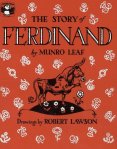
I was thinking today about two of my favorite childhood picture books: “The Story of Ferdinand” by Munro Leaf, and “Harold and the Purple Crayon” by Crockett Johnson. I read both of these over and over. I see now how they’ve influenced me for life.

Here’s today’s poem, a tribute to these two books. It’s rough, but from the heart.

Two Great Teachers

Ferdinand, from you I learned
The value of sitting in the clover
Quietly being true to yourself.
You and Harold
Were my first great teachers.
Ferdinand, I’m so glad you came along
When I was young to show me
conquests and prizes pale
Next to the victory of retaining
Your integrity. From you I learned
Contemplation.
Harold, with his crayon, spurred my creativity,
Showed me I could travel anywhere
Be anything, have wondrous adventures,
No matter my circumstances,
Without depending on someone else,
Without a car or bike or money,
As long as I had imagination.

If you need to find me, I’ll be
Traveling this world and others
In my clover patch.

Does Listening Count as Reading?

For the first time in several years, I have a regular driving commute. Not to work. I still have the same job to which I walk. But my mom lives in town now, in a nursing home about five miles from my house.  That’s a 30 to 40 minute round trip, depending on traffic and weather. I’m making it out there five times per week, so far.

My attempt to make lemonade out of fossil fuels involves checking out lots of music CDs and audio books from the public library. Currently, I’m listening to Haven Kimmel’s memoir, “She Got Up Off the Couch.” I’m getting a real kick out of it. But I have a dilemma about what to do once it’s finished. See, I have these weird OCD habits about keeping a record of what I’ve read. Should I add this book to the list?

It was much simpler when my kids were little and I was listening to children’s audiobooks with them on occasion. Because my rules don’t require me to list things read for someone else’s benefit.

I’ve never counted seeing a movie the same as reading the book from which the movie was made. But this is an unabridged actual reading of the real text. Does it count as reading? Since my schedule is ever more full, I’m trying to make up for lack of looking at text time by using audiobooks as a substitute. I don’t have a problem with listening to a book. My only problem comes with saying, even just to myself, that I read it, when really someone read it to me. For purposes of accommodating my own personality quirks, I think I may have to embrace the asterisk as my savior.


Royalty Mania

Here’s a little story in dialogue I wrote three or four years ago. At the time, it was done as an exercise and I considered it over-the-top satire. However, check the link I provide after.

An Arresting Conversation

“Did you hear Dee was arrested last night?”

“What for”

“Violating intellectual property rights. It was only a matter of time before she was caught, of course. I don’t know how she thought she’d get away with it. Wasn’t it just obvious, walking into a bookstore with four children and buying only one copy of a book?”

“I don’t know how anyone with a large family does it any more. It must be difficult to pay for four of everything.”

“That’s why I stopped after one child. I don’t believe it’s responsible to keep having so many kids if you can’t afford to raise them within the law.”

“She might not be guilty, though. Just because she only had one copy of the book doesn’t mean she was reading it to all the kids at the same time. Maybe she bought it for only one of them. Or else she was taking turns reading it to each child individually. I’m pretty sure that’s legal, reading the same copy of a book to different children in the family. So long as no more than one child is being read to at a time. The evidence seems pretty circumstantial to me.”

“There were witnesses. Hell, she wasn’t even trying to hide it. She sat right out on her front porch with three of her children and read to them all at once from one copy of the same book. In plain view of everyone. At least she didn’t have the 11-year-old out there. I’ve heard rumors she still reads to him, even though he’s clearly past the 10-year-old legal cutoff age for any sort of literacy sharing.”

“I never understood how the government decided on 10 as the age at which you have to stop reading to kids. It seems so young in some ways.”

“If the schools are doing any job at all, a child should be well able to read anything they need to on their own by that age. Of course if a child has a learning disability, their parents can get an exemption with a signed form from an educational professional.

“I still don’t know how Dee could be so stupid. Doesn’t she remember all the trouble Lisa got into last year when she was caught singing copyrighted lullabies to her toddler?And another thing. Don’t these mothers even care what values they’re instilling in their kids? They’re raising them to be thieves.”

“Sometimes I wonder, though…I have fond memories of my parents singing to me, and of us reading together as a family. We didn’t have a lot of money, so that was our entertainment. It was free back then. In a way, it seems like things were simpler in those days.”

“It was free to you, maybe, but at the expense of someone else. Food is free, too, for the person who shoplifts it.”

“I know there has to be some regulation. But do you ever think the laws have gone a little too far?”

“Oh, come on! Do you really want to go back to the days of hand-me-down clothes and libraries?”

“I’m not an extremist. I was only thinking it wouldn’t hurt anyone for there to be a little more leeway for someone like Dee, who’s struggling with all those children. Maybe as long as she wasn’t reading to children outside her own family, she should be allowed probation. It does seem like the compassionate thing to do.

“Then again, can we say she was reading only to her kids, when she was sitting right outside where anybody walking by could hear? You’re way too naïve sometimes. Dee’s not the innocent you take her for. I’ve never mentioned this to anyone, but she’s stolen from me before.”

“You’re kidding! What did she take?”

“She was with me one day when I told my son…Never mind exactly what I said to him. But I was using one of my own original childrearing techniques with a script I had written myself. When Dee saw how well my discipline method worked, she laughed and told me she was going to remember it. Not a week later she used my exact words to one of her own children right in front of me. Didn’t offer me a cent of reimbursement…I can see you’re surprised. I was too. I couldn’t have felt more shocked if she had grabbed the purse from my arm and walked off with it.”

“Speaking of kids, I have to feed mine. I’d better go and get some dinner started.”

“What are you cooking tonight? I could sell you some of my recipes if you ever run out of ideas.”

“Thanks but I inherited plenty from my parents. See you later – trademark.”

**

Apparently there’s a group in Belgium who would see this as a utopian scenario, as they want libraries to pay royalties for story time.


Local Travelogue One

“I have traveled a great deal in Concord.” – Henry David Thoreau

My husband, kids and I have taken two major vacations and several minor road trips. (The kids are 16 and 13.) The first major do was a drive to the Grand Canyon in 2006. That trip involved a lot of camping and one tornado. The other was a trip to Florida this past November, marking our first experience of flying together as a family.

I’d love to travel more, but in the past month, my life has taken a turn that promises to keep me anchored for the foreseeable future. So I’ve decided to take Thoreau as my inspiration and travel my hometown. To that end, my first hyper-local travelogue in photos.

This slideshow requires JavaScript.

So Many Mistake

Ring the bells that still can ring
Forget your perfect offering.
– Leonard Cohen (“Anthem”)

I want to take a moment to acknowledge that I make a lot of mistakes in my blog posts. Get used to it. I have. I generally write and publish them immediately, with very little rewriting.  I do try to proofread, but you know you can never catch your own mistakes when you proofread the same day. No matter how carefully I think I’ve looked over my post before I hit the “publish” button, I almost always find a typo later. I fretted over this for a bit, but I’m over it now.

When I write stories or poems for publication, I rewrite and proofread, and rewrite and proofread, lather, rinse, repeat. Yes, I know this is publication, but not the same kind. I’ve decided this is the place where I will allow myself to be gloriously open and flawed. This is my arena for just getting my thoughts out there, and I hope I’m providing some value, even if it’s not perfect. Sometimes, when I look at someone else’s blog and see a mistake or two, I enjoy it even more, because I’m reminded there’s a human being behind it. There’s a connection there. I’d like to think it’s a reciprocal feeling, at least sometimes.


Let’s Be Purists

Here’s a phrase I’d like to see used only in its original context: “lowest common denominator.” I suggest we stick to purist principles and use these words only in relation to actual math problems. I’m feeling pretty done with hearing the expression applied to human beings, especially children. To be honest, I’ve used it myself in the past. But I’ve declared a personal moratorium on it.

Think about it. That kid who is struggling with his reading – he’s a real person. He’s someone’s child. The girl who takes a few minutes longer than your kid to figure out the least common denominator in math class – she’s a human, and she’s good at something that some of the other kids aren’t. Every child, and every adult for that matter, struggles with something, and nobody wants to be ridiculed for it.

If I want my humanity recognized, I need to recognize it in others, and not use dismissive terms. Lowest Common Denominator, I hereby by banish you from the realm of humanity-describing adjectives.