Book Thoughts: Sharp Teeth by Toby Barlow

Working in a public library as I do, I’m often reminded of how much has already been written. Occasionally I look around at the shelves full of books and think “It’s all been done already. We can all stop writing now.”  But I’m happy to report I’m consistently proved wrong.

For instance: Sharp Teeth by Toby Barlow. A werewolf novel written entirely in verse. Epic verse isn’t new, of course. And werewolf novels are everywhere right now. But a combination of the two? I couldn’t not read it, figuring it couldn’t be mediocre; it had to be completely terrible or really, really good.

I count the book a success on all counts. It works as a novel, with engaging characters and an intriguing plot. There’s love and life and death and power plays and vengeance, and confused characters muddling through life caught up in it all. And it works as poetry, the choice of words and meter striking the place in you where poetry strikes, and still keeping the story flowing.  Example: “At night he lies down on the benches and contemplates/ the deception of starlight, long dead suns making small lights/ almost bright enough to guide the way.”

Barlow gets the balance right, sacrificing neither the fiction nor the poetry aspect in the cause of the other.

Is it obvious how much I liked this book? It’s so nice to come across something fresh, a reminder that we humans are endlessly creative. And it’s nice to see a writer following his own vision and making it work. I’m thinking of all of those writing conferences where authors are asking what editors are looking for at the moment, and nobody ever answers “Werewolf poetry.”

I have one warning for the squeamish. Though not gratuitous because it does serve the story, some of the violence is quite graphic.

Writing Poetry

I’ve always liked poetry. For years, I’ve made a habit of reading at least one poem every day. I do skip a day now and then, but not often.

My writing has focused more on poetry than prose, as well, until about two years ago. Over the past couple of years I’ve been focused on a novel and have been struck with many ideas for short stories, and the poetry has fallen off quite a bit.

But, with the novel more or less finished, I took the arrival of April – National Poetry Month – to get back myself back into the poetic mode. I’ve been writing a poem every day. It’s been good for me. I get a lot out writing in general, but I’m rediscovering the value of writing poetry specifically.

~Edith Södergran said “I don’t create poetry, I create myself, for me my poems are a way to me. ”  For me, this rings true. Even when I compose a bad poem, I often develop new insights in the process. For instance, this month I’ve realized one reason why I still pray sometimes, even though I’m agnostic; it helps me focus on what’s important to me. I guess I could say the same for poetry. I came to this new knowledge of myself because I started writing a poem about prayer.

Writing a poem, too, makes me really look at, listen to, and experience the world in a conscious way. For me, then, poetry is a path of mindfulness, and a way to keep myself connected to the universe.

I’m glad I made the decision to reconnect with my poetic muse. It’s an enriching relationship.

Obligatory Cat Poem

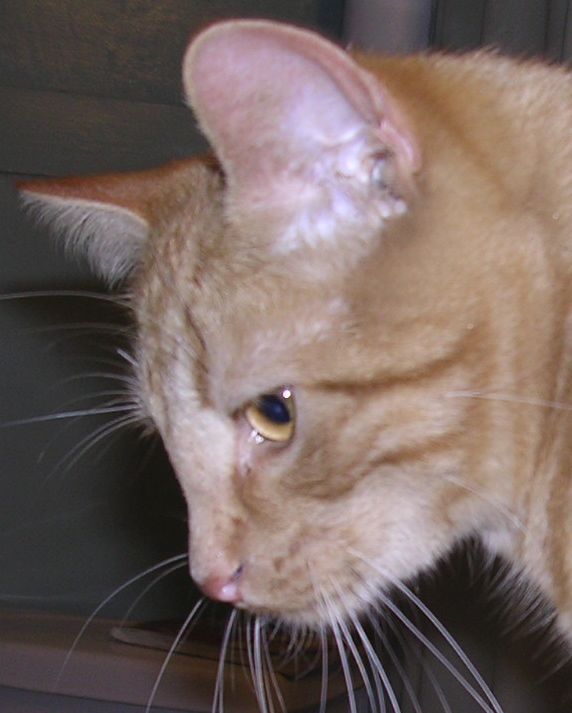
I say obligatory because so many poets write about cats. My family’s cat, Dude, really was a cat in a million, and I loved him unreasonably.

So far, I’ve managed to write a poem every day this April. This is one of them.

Dude

Hang around cat
Amber eyes surrounded by
Orange on orange
All attached to a companionable
Nonchalance
Not a lap cat
Not a fighting cat
Not a recluse cat
But a hang around cat
If you’d been human, you’d always
Have had a light for the buddy’s
Cigarette and a six pack of beer to share
But no advice
Only a thereness for everyone
To come to depend upon
As the humans in your household did
With your catness
Some part of your thereness is still here
Even if you aren’t

April Fool’s Resolutions

The dead of winter doesn’t really seem like a great time for making a fresh start. I think spring, about two weeks in, is more appropriate. So in that spirit, I’ve written a poem containing my April Fool’s resolutions.

April Fool’s Resolutions

Starting today

I resolve to play more tricks
on my family and my friends,
to begin each day practicing
a silly walk,
to lose the weight of serious
introspection.

I will quit all smoking that does
not involve smoke bombs and all drinking
that does not involve a dribble glass.
I will save money
by crafting my own pranks at home;
Handmade is best.

I’ll study hard to learn new jokes.
Reorganize things, though I won’t say
whose.  I’ll seize each opportunity
to get a laugh
But most important of all, I resolve
to watch my back.

Cosmic Pushback

And the fates laughed. I knew that as soon as I made a plan, the universe would rebel.

“You have five hours scheduled into your week for writing? How about if I send you a rotator cuff injury? What if you had to spend your time on doctor’s appointments, special exercises and ice packs, all while moving at 75% your usual speed? What then, hmmm? Think you can handle it? How about if I pile on two unexpected snow days out of school for your children? Think you’ll do those five hours now?”

And I reply:  Ohhhmmmmmmm. I will not wait for my normal life before I start writing. Ohhhmmmmmmm. This is normal life; I will write anyway.

But I didn’t make my five hours the first week. My writing log tells me I clocked a total of 4.1 hours. Looks like I have some make-up to do in the next seven days.

A Writer’s Resolutions for 2010

I’d like to announce that I’ve already made progress on my writing-related goals for 2010 by improving my blog, however slightly. Look over to the right.  I finally have a “follow” button and have also add an RSS feed option.

My writing goals for the coming year and beyond can be summed up under one umbrella resolution: Treat my writing more like a job. This means I will establish regular office hours and I can’t take off from work willy-nilly. If I need to miss work, then I’ll need to make up the hours.  With the demands of my “real” job, my old house, my two children, my pets, etc. I find it all too easy to sacrifice my writing time to dentists and veterinarians and school staff who need volunteers to help with a project, not to mention all the time I spend at the hardware store. Since my regular job is part-time, in theory I have a couple of days a week when the kids are in school that I should be able to devote to my writing. In reality, those are the days I end up doing all of my appointments and errands. Then I try to fit in the writing around all the rest. A lot of times, the writing doesn’t happen. I aim to change this.

I’ve broken down my general intention into smaller, specific goals. From past experience I’ve learned I need to keep my goals limited to things I can control.  So my list doesn’t include the goal of having someone else publish a piece of my writing, but it does include how many pieces of writing I want to finish and send out during the year. The hope is to have them published, of course, but since I can only control my end of the process, that’s where I need to focus.

My list of writing goals:

Set regular office hours and stick to them, at least five hours per week.

Finish the rewrite on my novel and offer it for consideration to at least ten outlets (publishers and/or agents) before the end of the year, unless someone accepts it before I reach ten.

Write at least four short stories and send them out into the world. I decided on four for the year, because I have four ideas floating in my head right now.

I currently have a book of poetry entered in a contest. If I don’t win that, I will offer the manuscript for consideration to at least ten other outlets or until it is accepted for publication, whichever comes first.

I will not let a month end without sending out at least one item.

I’ll update my blog at least three times each month. I figure once every ten days or so is a minimum. I will learn more about the nifty features of my blog and attempt to improve it.

Happy 2010 everyone! Let’s get some writing done!

Vocabulary

I used to pride myself on having a large vocabulary. I know words such as noesis, after all. I even know and use some words you only find in the most unabridged of dictionaries. Stoit, for example, means to move in a staggering fashion, like Captain Jack Sparrow in those pirate movies. When I was a kid, I always aced vocabulary tests in school.

Then one day, I was walking with a friend and pointed out the lovely violets in someone’s yard. She corrected me, letting me know the plant was creeping myrtle. Since I have a brown thumb, I’m not great on plant names. The more I thought about it, the more I realized there are whole subject areas of vocabulary in which I’m deficient: plants, cooking, knitting.  What does al dente mean anyway? What are you doing when you braise something? Is a purl a little bead you fasten into your scarf?

One of the most generally known rules of good writing is “be specific.” Don’t say “tree.” Say “juniper” or “thorny locust.”  How can I be a good writer if I don’t know the difference between violets and creeping myrtle?

It turns out other writers have the same problem, this lack of an omniscient vocabulary. Nobody knows everything about every subject. That’s where research comes in. If I want to have one of my characters knitting and speaking knowledgably of the process, I don’t have to have the knowledge already stored in my brain. I can read knitting magazines, books and blogs, and talk to one of the 1,000 people I know who do knit in order to lay some nifty terminology into my story.

Writer’s Digest has a whole series of books dealing with need-to-know information in different areas. Need to poison one of your characters, but don’t know much about poisons? Serita Stevens will help you out with the Book of Poisons: A Guide for Writers.  Want to get your legal vocabulary straight for a courtroom scene? Try Order in the Court: A Writer’s Guide to the Legal System by David S. Mullally. Not clear on the difference between an abrasion and a contusion? You may want to browse Body Trauma: A Writer’s Guide to Wounds and Injuries by David W. Page.

Violets: 

Creeping Myrtle:

The pay off

My son is in middle school and bumping up against a dilemma faced by many writers. How willing should you be to sacrifice your artistic vision for  pay? In this case, the payoff is a grade. We’re finding, sadly, that the writing taught in language arts in our local schools is preparing the students to conform to the formula required on the MAP test (Missouri Assessment Program.)

In my son’s class, they’ve been working on memoir writing. He decided to write about how he came to be obsessed with Lego architecture, something that began with a trip to Chicago, where he discovered a Lego version of the Sears Tower. So far, so good. It’s not a bad choice for an 11-year-old. But he wanted to make his piece stand out. He told me he didn’t want to just write down a list of events. He and I brainstormed for a while and he came up with a pretty original writing plan; he would write a backward memoir.

So he started the piece with the most recent relevant event, then explained how it had been spawned by a previous event and how that had grown out of something that happened before, and so on. Right back to our trip to Chicago. He was pleased with  how well the idea worked and so was I. He had attained his goal of writing something that was interesting and stood out from the rest of the memoirs in the class.

Therein lay the problem. He wasn’t supposed to write something different. He got marked down because the scoring guideline states memoirs are supposed to relate events in the order they happened. Tell that to Dave Eggers. Hmph!

To be fair, the teacher presented things honestly. The students were told what to do to get the best score, and my son did decide to do it a different way. It’s a decision he’ll have to keep making. Does he want to find his own voice to do the best writing he can, or does he want the grade? In a way, the fact that Language Arts is not his favorite subject might make it easier for him to choose the higher grade. He’s a lot more passionate about science. On the other hand, he might have inherited enough of my personality to figure it’s worth sacrificing a grade in order to make a statement.

It’ll be interesting to see him choose his path.