A Writer’s Resolutions for 2010

I’d like to announce that I’ve already made progress on my writing-related goals for 2010 by improving my blog, however slightly. Look over to the right.  I finally have a “follow” button and have also add an RSS feed option.

My writing goals for the coming year and beyond can be summed up under one umbrella resolution: Treat my writing more like a job. This means I will establish regular office hours and I can’t take off from work willy-nilly. If I need to miss work, then I’ll need to make up the hours.  With the demands of my “real” job, my old house, my two children, my pets, etc. I find it all too easy to sacrifice my writing time to dentists and veterinarians and school staff who need volunteers to help with a project, not to mention all the time I spend at the hardware store. Since my regular job is part-time, in theory I have a couple of days a week when the kids are in school that I should be able to devote to my writing. In reality, those are the days I end up doing all of my appointments and errands. Then I try to fit in the writing around all the rest. A lot of times, the writing doesn’t happen. I aim to change this.

I’ve broken down my general intention into smaller, specific goals. From past experience I’ve learned I need to keep my goals limited to things I can control.  So my list doesn’t include the goal of having someone else publish a piece of my writing, but it does include how many pieces of writing I want to finish and send out during the year. The hope is to have them published, of course, but since I can only control my end of the process, that’s where I need to focus.

My list of writing goals:

Set regular office hours and stick to them, at least five hours per week.

Finish the rewrite on my novel and offer it for consideration to at least ten outlets (publishers and/or agents) before the end of the year, unless someone accepts it before I reach ten.

Write at least four short stories and send them out into the world. I decided on four for the year, because I have four ideas floating in my head right now.

I currently have a book of poetry entered in a contest. If I don’t win that, I will offer the manuscript for consideration to at least ten other outlets or until it is accepted for publication, whichever comes first.

I will not let a month end without sending out at least one item.

I’ll update my blog at least three times each month. I figure once every ten days or so is a minimum. I will learn more about the nifty features of my blog and attempt to improve it.

Happy 2010 everyone! Let’s get some writing done!

Vocabulary

I used to pride myself on having a large vocabulary. I know words such as noesis, after all. I even know and use some words you only find in the most unabridged of dictionaries. Stoit, for example, means to move in a staggering fashion, like Captain Jack Sparrow in those pirate movies. When I was a kid, I always aced vocabulary tests in school.

Then one day, I was walking with a friend and pointed out the lovely violets in someone’s yard. She corrected me, letting me know the plant was creeping myrtle. Since I have a brown thumb, I’m not great on plant names. The more I thought about it, the more I realized there are whole subject areas of vocabulary in which I’m deficient: plants, cooking, knitting.  What does al dente mean anyway? What are you doing when you braise something? Is a purl a little bead you fasten into your scarf?

One of the most generally known rules of good writing is “be specific.” Don’t say “tree.” Say “juniper” or “thorny locust.”  How can I be a good writer if I don’t know the difference between violets and creeping myrtle?

It turns out other writers have the same problem, this lack of an omniscient vocabulary. Nobody knows everything about every subject. That’s where research comes in. If I want to have one of my characters knitting and speaking knowledgably of the process, I don’t have to have the knowledge already stored in my brain. I can read knitting magazines, books and blogs, and talk to one of the 1,000 people I know who do knit in order to lay some nifty terminology into my story.

Writer’s Digest has a whole series of books dealing with need-to-know information in different areas. Need to poison one of your characters, but don’t know much about poisons? Serita Stevens will help you out with the Book of Poisons: A Guide for Writers.  Want to get your legal vocabulary straight for a courtroom scene? Try Order in the Court: A Writer’s Guide to the Legal System by David S. Mullally. Not clear on the difference between an abrasion and a contusion? You may want to browse Body Trauma: A Writer’s Guide to Wounds and Injuries by David W. Page.

Violets: 

Creeping Myrtle:

Public Art

After visiting Chicago, and particularly Millenium Park, this past summer, I started thinking a lot about public art. I decided I have an opinion on the subject. I’m strongly in favor of public art, for a lot of the same reasons I’m in favor of public libraries. Information and literature and music and visual art should be available to everyone, not reserved for a privileged few.
I suspect that even the most curmudgeonly of complainers against spending tax money on art do actually enjoy some aspects of it. I’d bet you could find a lot of these folks at the publicly funded fireworks display on July 4th, for example.
My favorite installation at Millenium Park was the Cloud Gate Sculpture. My family and I spent a good hour looking at this one piece of art from every possible angle.

Another Snake

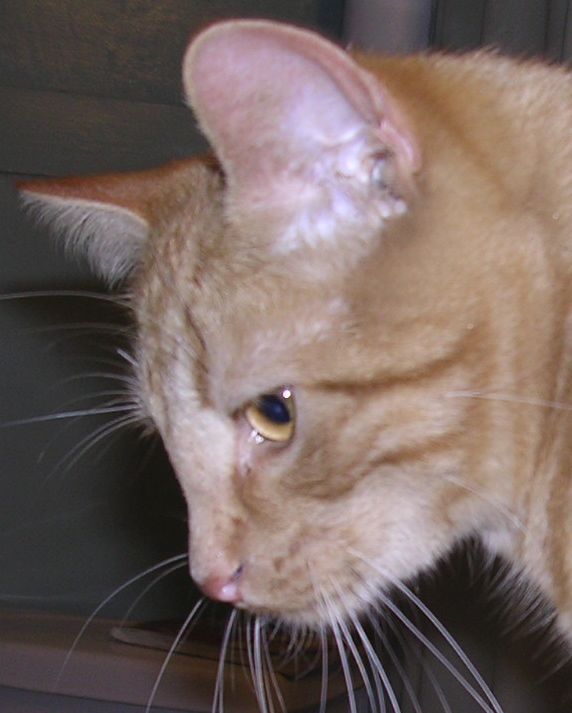
Shortly after I posted the poem about accidentally mowing a snake into pieces (the headless fellow in the grass), I was given a chance to make some amends to the world of snakes.  My cat, of whom I never would have expected this, caught a snake and brought it to me.

The reason I wouldn’t have expected it is because this particular cat has a deep and abiding love for the indoors. About once a day, she stands at the door mewing desperately to be let out. Once the door is open, she ventures as far as the edge of the porch and has been known to remain there for as long as 90 seconds before spiraling into regret over the terrible mistake she’s made. Then she mews desperately at the other side of the door until someone lets her back in. Nobody would peg her as a snake catcher.

I didn’t count on her finding a snake in our basement. But the other day as I sat in the living room, typing away on my laptop, she came trotting up from the basement with something long and skinny dangling from her mouth. When she dropped it in front of me, it slithered. It slithered with amazing speed. She pounced, it struck at her, she picked it up again, it writhed away again, she batted at it and I realized intervention was needed.

After an untaped, never to be seen episode of Funniest Home Videos, involving me, the cat, the snake, lots of yelling, hissing, slithering, stalking, running, tripping over chairs, and ultimately, the use of a Rubbermaid container, I managed to set the snake free outside. Through great personal effort, I had saved it from my cat. And thus balance was restored to the universe.

The pay off

My son is in middle school and bumping up against a dilemma faced by many writers. How willing should you be to sacrifice your artistic vision for  pay? In this case, the payoff is a grade. We’re finding, sadly, that the writing taught in language arts in our local schools is preparing the students to conform to the formula required on the MAP test (Missouri Assessment Program.)

In my son’s class, they’ve been working on memoir writing. He decided to write about how he came to be obsessed with Lego architecture, something that began with a trip to Chicago, where he discovered a Lego version of the Sears Tower. So far, so good. It’s not a bad choice for an 11-year-old. But he wanted to make his piece stand out. He told me he didn’t want to just write down a list of events. He and I brainstormed for a while and he came up with a pretty original writing plan; he would write a backward memoir.

So he started the piece with the most recent relevant event, then explained how it had been spawned by a previous event and how that had grown out of something that happened before, and so on. Right back to our trip to Chicago. He was pleased with  how well the idea worked and so was I. He had attained his goal of writing something that was interesting and stood out from the rest of the memoirs in the class.

Therein lay the problem. He wasn’t supposed to write something different. He got marked down because the scoring guideline states memoirs are supposed to relate events in the order they happened. Tell that to Dave Eggers. Hmph!

To be fair, the teacher presented things honestly. The students were told what to do to get the best score, and my son did decide to do it a different way. It’s a decision he’ll have to keep making. Does he want to find his own voice to do the best writing he can, or does he want the grade? In a way, the fact that Language Arts is not his favorite subject might make it easier for him to choose the higher grade. He’s a lot more passionate about science. On the other hand, he might have inherited enough of my personality to figure it’s worth sacrificing a grade in order to make a statement.

It’ll be interesting to see him choose his path.

Book List: Libraries

Time for another book list. I figure people who are interested in book lists are interested in libraries, so that’s my theme this time around. I haven’t included instructional books about how to use a library or decode a particular classification system, but I did find a fair amount of non-fiction to include.

Fiction

Applied Mythology
by Jody Lynn Nye
What will become of the not-so-mythical-after-all creatures who inhabit the basement of the university library when the old building is torn down?

Bibliophilia: a Novella and Stories
by Michael Griffith
Humor and sex and shushing all in one book.

The Body in the Library
by Agatha Christie
A Miss Marple mystery.

The Burglar in the Library
by Lawrence Block
Not a Miss Marple mystery, but a mystery nontheless. Bernie Rhodenbarr, actually but I like the way “Miss Marple mystery” sounds so much I made up an excuse to repeat it twice.

The Case of the Missing Books
by Ian Samson
Mystery. Where could 15,000 missing library books have gone in an Irish village?

The Destruction of the Books
Mel Odom
Sci Fi. It’s up to the librarians to save the world. Just as in real life.

Ex-libris
Ross King
A  quest to track down a missing library book. Set in the 17th century England.

The Geographer’s Library
Jon Fasman
Smugglers involved in alchemy operate secret libraries? This is one I’ve got to read.

Instant Karma
Mark Swartz
Conspiracy theorist and potential terrorist stalks the Chicago Public Library.

Library: No Murder Aloud
Susan Steiner
Mystery. I guess if they’re kept quiet, it’s okay.

Lord of the Libraries
Mel Odom
SciFi. Odom knows how to pick heroes. It’s the librarian to the rescue again.

Miss Zukas and the Library Murders
Jo Dereske
Mystery. What is a research librarian but another form of detective, really?

Mobile Library Mysteries – series
Ian Samson
Mystery. Series.

Murder at the Library of Congress
Margaret Truman
Mystery. And all over some old diary by a guy named Columbus.

The Name of the Rose
Umberto Eco
14th Century Monastic library, heresy, murders.

Open and Closed
Mat Coward
Mystery. Library advocates – can the threatened closing of their favorite facility lead them to murder?

The Story of General Dann and Mara’s Daughter, Griot and the Snow Dog
Doris Lessing
Want to save civilization? Find a library.

Non-fiction

At Home With Books: How Booklovers Live With and Care for Their Libraries
Estelle Ellis
The art and style of the home library.

Banned in the U.S.A.: a Reference Guide to Book Censorship in Schools and Public Libraries
Herbert N. Foerstel
Fairly self-explanatory I think.

Dewey: the Small-Town Library Cat Who Touched the World
Vicki Myron
Again, the synopsis is in the title.

Double Fold: Libraries and the Assault on Paper
Nicholson Baker
Who will save the historical newspapers? Nicholson Baker. Or at least he’ll try his darndest.

Free for All: Oddballs, Geeks and Gangstas in the Public Library
Don Borchert
Hilarious and alarming all at the same. And I’m in a position to tell you none of it seems exaggerated from an insider’s perspective.

Home Office: Library and Den Design
Tina Skinner
You got those books and things. How ya gonna organize ’em?

Homes and Libraries of the Presidents
William G. Clotworthy
U.S. Presidents, that is.

The Ideals Guide to Presidential Homes and Libraries
Peggy Schaefer
Again, U.S. presidents.

Interlibrary Loan Sharks and Seedy Roms: Cartoons from Libraryland
Benita L. Epstein
Really funny cartoons for those who frequent or work in libraries.

Libraries in the Ancient World
Lionel Casson
Starting with clay tablets.

Library: an Unquiet History
Matthew Battles
Viva la revolu – er, library!

The Library at Night
Alberto Manguel
Life = reading. Reading = life.

Patience and Fortitude: a Roving Chronicle of Book People, Book Places, and Book Culture
Nicholas A. Basbanes
An exploration of bibliomania and bibliomaniacs.

The Raven King: Matthia Corvinas and the Fate of His Lost Library
Marcus Tanner
A book about a Hungarian king and the place he and the library he built occupy in history.

Quiet, Please: Dispatches from a Public Librarian
Scott Douglas
Memoir from a library employee. More about the people than the books.

Reading Rooms: America’s Foremost Writers Celebrate Our Public Libraries with Stories, Memoirs, Essays and Poems
Publisher: Doubleday
An anthology, in case you hadn’t figured that out.

Unshelved Collection:
Bill Barnes
Cartoon series on library matters.

With Apologies to Emily Dickinson

My Snake

A headless fellow in the grass
Bleeding and lifeless lies,
I did not see him, till too late.
Mower blades met him first.

Grass is short now; he lies exposed,
His stripes truncate too soon;
Tip of the tail is severed, too.
He died this afternoon.

He liked the elm tree’s shade,
Protected from the sun
He made a nest at its roots,
Was sleeping there this morn.

Many days I’ve seen him slither
And pass before my feet.
I never meant him harm; when
I saw him, I’d retreat.

Several of these snakes I’ve had
Abiding in my yard,
Neither of us aggressive,
Yet both kept on our guard.

But never met one so close
By accident or purpose,
To touch him with my hand
Or with the blade’s sharp surface.

**

This is based on an incident from a couple of years ago. I started a poem about it then and forgot it until recently. I found the nearly finished poem earlier this week and brought it to its conclusion. I really didn’t run over the snake on purpose.

Submission Tracking

Every writer I know has her or his own method for tracking submissions, except for those who don’t. Since I’ve always admired Wallace Stevens as much for his actuarial skills as for his poetry, I’m one of those who does keep track. My check book is always balanced, too.

Many writers use spread sheets and I’ve heard tell of special software designed specifically for the task of submission tracking. I’ve invented my own method that integrates the creative writing half of my brain with the accounting half. So it’s a bit less accounting than the aforementioned methods, but also a bit more entertaining.

I color-code the file name of each piece of writing I have stored on my hard-drive according to it’s current status. Plain black means it needs more work before I send it out. Red means I feel the piece is ready to spread its wings and fly, but either I haven’t nudged it from the nest yet or else it’s come back home to live for a while after the moving out thing didn’t work so well. Blue is for work I’ve sent out but for which I haven’t yet heard anything. Green means a piece has been accepted.

I also keep a note on the bottom of each piece, informing me of where I’ve sent it and when, etc., information I duplicate in one large word document I have oh so creatively named “Submissions List.” The information in “Submissions List” is colored coded as well. Here black means rejection, red means waiting to hear, and green is accepted. Purple, a color I’ve used exactly once so far, means my piece was rejected but somehow the editor made me feel so good about it.

I have one paragraph for each submission. I always include what I sent, where I sent it and when, what they say their reporting time is, and how much they pay. When I hear back I add in the date I heard & what the status is. In addition I sometimes include insights into my mood at the time of submission and rejection. For some reason I’ve found no need for extra notes to myself upon acceptance. Not so with rejections.

I was scrolling back through the entire list earlier today and found some notes I’d forgotten about. I suppose they probably run the typical gamut for a writer’s reactions. Here are some samples:

I have plenty of “will assume it’s rejected if I haven’t heard by now.”

“11/20 sent poem to ‘Poetry of the Sacred’ contest. 02/01 – Didn’t win shit.”

“Rejected in the mailroom, judging by the speed.”

I have a few “rejected, though with a nice note.”

At one point in my list I have 15 rejections in a row with no comment, followed by a sixteenth with the word “sigh” at the end & a seventeenth with the words “boo hoo.”

“5/24 sent three poems to XX…All rejected 07/25/05. Without returning manuscripts, even though I sent adequate postage. So I had false hope when I realized the envelope contained only one page, thinking it was an acceptance. Blppppthhhh!”

“07/27… sent three poems to …XX via snail mail. … Rejected 02/21. They waited long enough that postage rates went up, so they had to add 2 cents to my SASE. Ha! My little unplanned raspberry back at them.”

“09/16… sent essay to XX via snail mail. …Returned 12/05 with illegible handwriting that I assume was a rejection since it included the first page (only?) of my manuscript and no contract. They used the rest of my postage to send me adverts for their mag. Instead of my manuscript.” (Extra note for other writers – I will identify this magazine. It was GreenPrints. Now you know, if you send them something, only include enough return postage for one page.)

11/16…sent essay to XX …  So now it’s double submitted, as I still haven’t heard from YY.  Whoa, I’m getting daring.  Rejected 01/05 with a very nice note saying she was making a point of sending me a personal note to say she found my piece exceptionally well done, but thematically it didn’t fit. I take what consolation I can get.”

“01/22… sent three poems to XX via snail mail…I will have a heart attack if they accept one of my poems. 02/09/06 – no need for the defibrillator.”

“02/06 sent four poems to XX, anthology of poems about motherhood. …made first cut!!! ‘Will likely hear from them again in the fall.’  09/15..Didn’t make final cut.  Too bad their book will be such poor quality.”

“07/11…sent story to Alfred Hitchcock Mystery Mag. Pro market.  Snail mail. Rejected 01/16…but it was a “nice” rejection w/handwritten extra note.” (Note: I included the name of this mag as well because I’m still impressed that an editor at such a large publication would take the time to handwrite a nice little extra page.)

“07/25…entered piece in XX writing contest…11/01 Put a big L on my forehead.”

“04/09 sent poetry book manuscript to XX contest ..Because it was a more interesting way of disposing of $25 than flushing it down the toilet.”

**

Since I’m nothing but professional and courteous in my communication with editors, I find keeping this list on my computer is a good way to vent my feelings. Also, I like to remember whether a particular publication is a market I want to try again or not. Maybe my little system is submission and attitude tracking.

The Right Book at the Right Time

A friend recently shared the information that her daughter had been assigned to read the book Beloved by Toni Morrison for a high school class last spring. The daughter struggled through the text, disliking it all the way through.

Beloved is one of my favorite works of literature. But I first read it in my early thirties, after my children were born. Would I have understood the book at age 16? Parts, I think. Would I have liked it? I’m not sure, but I think not. I came upon the book at the right time in my life, after I’d had enough life experience to be haunted by some true regrets.

Thinking back, I can recall books I’ve read in years past that left me shaking my head in bewilderment. Crime and Punishment comes to mind. I wonder if I should re-read it now. Maybe I’d get it in some fundamental way I didn’t before. Or maybe not.

I did read, enjoy, and understand many “adult-level” books in my adolescence. So I’ve put very few restrictions on what my kids read.  I think they’ll either be ready for a book or they won’t and they’ll figure it out for themselves. Maybe there are hundreds of teens out there who do appreciate Beloved. Maybe there are even some who appreciate Crime and Punishment.

I remember the first true grown-up book I read and enjoyed. It was A Tale of Two Cities. But I had started to read it twice before I finally finished it on the third go.

My 11-year-old son just finished reading the Harry Potter series. When he was younger, we read the first couple of books to him, but he lost interest even as the rest of us in the family were avidly reading and discussing the series. He’d say “I don’t see what the big deal is. I don’t think they’re interesting.”

Then one day around his 11th birthday (the same age as the main character at the beginning of the story), he was looking for something to do, having used his allowed computer time for the day. He spotted Harry Potter and the Sorcerer’s Stone lying out on top of the bookcase and picked it up. Two hours later, he looked up and told me “This book is better than I remembered.”

He proceeded to read all seven books straight through. He’d become ready for them.

I think what I’ve figured out is that not only should you not judge a book by its cover. You possibly shouldn’t even judge it by your first reading of it. True, there are many honestly terrible books out there. But sometimes a book I don’t like right off may deserve a second look.

A Whole Lot of Writing Going on

Through my local public library, I logged into an Infotrac database – General OneFile – to do some research. I stopped before I started, stunned into a case of the vapors by a number I saw: 83,083,630.

“Currently searching General OneFile with 83,083,630 articles…”

83 million articles?! Let me add some more punctuation to illustrate my reaction. ?????!!!!!?????!!!!!

Who wrote all of that? Why should I add to it? Should I add to it? Is there too much written already? Maybe people should stop writing for a while. How can I make my writing noticed in a sea of 83 million+ articles? Do people feel overwhelmed with written word overload? Would more written words be nothing  but piling on? Is there anything left that hasn’t already been written? Will the questions generated by this number never end?  All of this went through my head in about 10 seconds and then started looping on replay over and over.

On the other hand, if I believe writing and reading are worthy pursuits, can there be too much of either? And, if 83,083,630 articles have already been published, doesn’t that mean there are plenty of markets publishing stuff?

83,083,630. I’m trying to decide if the number is discouraging or encouraging.