Meanderings on writing, reading, walking, bicycling, and life
Author: thedamari
I live in Missouri, a more beautiful place than many realize. I love writing, reading, walking, bicycling, and making lists. I’ve written poetry since I was seven. A few years ago I branched out into short fiction and memoir pieces. I also perpetually have a novel in progress. My brain pursues ideas at a brisk pace, wandering all over the map. This blog represents one of my efforts to keep up with it.
The sky kept threatening rain all day, so Frieda and I stayed home. But it finally cleared enough that we felt safe going out after dinner this evening. My husband and son went along, too, though they rode off and left me a couple of times. (It’s okay. We all have phones.)
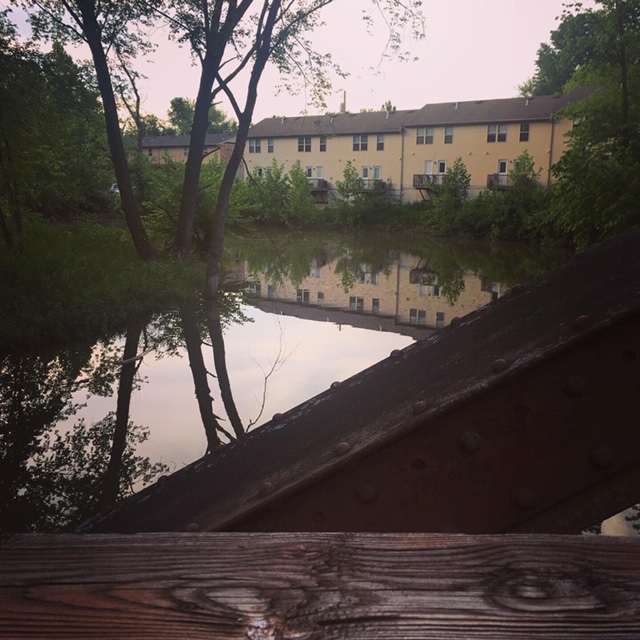
We’ve had a lot of storms lately, resulting in many closed roads around the area. I encountered a couple of muddy patches on the trail, but it was mostly okay. A few areas of standing water right off to the side.
I wanted to take more water pictures, but the one time I stopped, I got swarmed by mosquitos. Plus dusk was coming on. On one stretch, the only occupants of the trail were me, Frieda, the mosquitos and a deer. A doe ran right in front of me, but I didn’t get photos.
Here’s the only photo I snapped to document the water level. I’m pretty sure the creek is not supposed be nearly up to those apartment balconies:
Yesterday I was sitting in a waiting room while my son had some medical scans done. I always have a book handy for such occasions, but it was a little hard to enjoy it while the wall-mounted television blared at loud volume with some police drama involving the search for a child rapist/murderer.
Several other people were in the waiting room as well, including a couple of families with young children. I saw one pregnant mom and her partner trying to keep their kids distracted, as they moved to the far side of the room from the TV. Unfortunately, the show was audible from all corners. I could tell the program was disturbing them at least as much as it was me. I remember those pregnancy hormones and the instant overwhelming grief I would feel upon hearing of any harm to a child. Then, too, who wants their kids to hear discussions of children being horrifically murdered?
After the fourth mention or so from the TV characters about raped and murdered children, I went to the reception desk and asked if there was a way to change the channel. I think the woman working there had been focused on her work and managed to tune out the show. She looked up at the screen after I asked and seemed to realize then what was playing. She handed me a remote, saying, “Of course. Put it on whatever station you want.”
As I turned around with the remote in my hand, the pregnant mom looked me in the eye and offered the most sincere “thank you” I’ve ever heard. I’ve never had cable television, so I don’t even know about channels. “Is there a channel your family likes?” I asked her.
She shook her head. “It doesn’t matter. Anything but that.”
I flipped through a few, trying to find something non-controversial and non-traumatic. I settled on college baseball. After I returned the remote and sat back down, an older man near me thanked me as well.
Here’s the thing. I’m shy. I carry a lot of social anxiety around with me. But of everyone who wanted the channel changed, I was the only one who felt empowered to do something about it. I guess?
If you like police procedurals and want to watch whatever that show was at home, I’m not judging. I, too, sometimes enjoy shows where I feel like an evil doer is brought to justice. But it was so obviously inappropriate for the situation and so obviously distressing a number of people.
Let me give a little pep talk here. It’s not overstepping to say that something is distressing and politely request a remedy. You don’t have to sit there thinking it’s terrible but you just have to live with it. Folks, you have the right to request a channel change.
I’m using some accumulated PTO from work this week. That means more bike rides!
In a previous life, a quarter of a century ago, before having kids, I used to ride a lot. I rode for transportation. And I took long bike rides with my husband. I liked cycling back then. But I’m experiencing a new level of joy with it now. Maybe because I’ve experienced a couple of decades of not being able to just go, of always planning even the smallest moves in my day around other people and their needs.
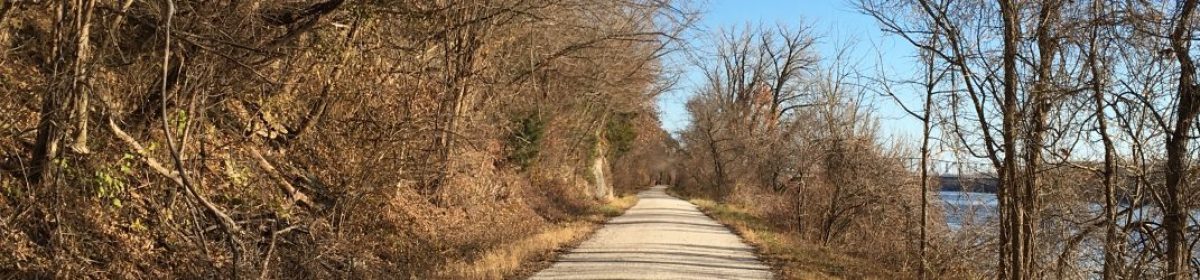
Summer has dropped itself on us here suddenly, as it does in Missouri. So I went out early (ish) this morning before it got too hot. I saw a fair number of bikers, runners and walkers on the trail, at least while I was still in city limits. I went out into the country a couple off miles before turning around.
On into the wild.
I’ll tell you this about myself on a bicycle — I’m not the fastest rider out there. I get passed by a lot of other riders. And I don’t care! That’s part of the joy of cycling alone. I don’t have to worry about keeping up with anyone. I set my own pace, stopping when I want and resuming when I want. I’m not competing with anyone.
I’m going to start substituting bike riding blog posts in place of walking ones, on occasion. I’ve had Frieda (my bicycle) for a few weeks now. My rides are getting a little longer, as weather and time permit.
Sure, I had stuff I should have been getting done around the house. But the weather couldn’t have been better. So Frieda and I boogied down the trail out of town, just far enough to see some cows.
We stand in fields and eat grass – cows.
Frieda at the cow pasture.
Erstwhile trestle
Having a mid-life crisis? Forget the ridiculous sports car. Get yourself a bicycle!
Nothing lasts forever. This is all that’s left of a trusty old tree that provided me a shady respite on my walk to work for the past several years.
My size 8 1/2 (Women’s American) foot for scale.
I have no idea how many rings are there. Many – let’s leave it at that. I’m sure the tree was older than some of the surrounding houses. Goodbye old friend.
Yesterday, the day before Easter, I took a more urban walk than usual, going through downtown to a day-long event. So no flowers in this post. Usual caveats apply — this is only to share my observations and experiences. I know my photos are as amateur as it gets.
I really want to spend a day sitting inside that tower looking out a window.
We had a long, long, long, hard, hard, hard winter here. What walks I took were utilitarian and accomplished as quickly as possible, with no taking off of gloves to snap photos.
But spring has arrived at long last. I see color popping here and there, new blossoms, life re-emerging.
We hunkered down, endured through the gray and cold. Then one day, there were flowers.







 Nomadic Noesis