Looking My Age

Since we’re all pondering the passing of time tonight, here’s a poem I wrote about aging, followed by some musings.

**

The Grottos of My Face

Lines I expected, around
the eyes and mouth, a deepening, settling
in of my features. This is how I aged
in my mind, at twenty, when I thought of aging
which wasn’t often, but enough
so that the image held fast, is there still
decades later, when I hit the snooze
each morning, until the second alarm
propels me through the shower
to the mirror, comb in hand. The third alarm
is the surprise that meets me there
new every day: the grottos
of my face, the shifting of the landscape.
No steady etching, as from
the river time is supposed
to be, according to the poets I’ve read.
Now I begin to see that age
is not a settling but an upheaval
unpredictable,  seismic.

**

2000px-aztec_calendar-svg

For most of my adult life, my appearance has been deceiving. I’ve looked younger than my actual age. Once, when I was in my early twenties, I was checking out books about writing from the library and the lady behind the desk asked “Are you hoping to be a writer when you grow up?” Umm.

I got ID-checked for 21-and-over activities right up to about age 40. But after age 45 or so, it the years started catching up with me and it seemed I could tell a difference in the mirror from one day to the next. I remember the morning I woke up with jowls. It was like having one of those tricky balloon mortgages where people float along complacent for years and years with their manageable payments, until suddenly one day – boom – they owe tens of thousands of dollars all at once.

I’m 51 years old now and I look it. I have a couple of gray streaks in my hair. I don’t plan to dye it, as I know myself too well to entertain the idea I’d ever keep up with it. Besides, I like gray hair, and the shade of gray I’m getting goes well with my blue eyes. I have creases in my face and the newest development is turkey neck.

I tell myself I’m okay with it. There’s nothing wrong with looking my age or being my age. As Sarah Silverman put it, about people mocking her for being “old”:  “I feel like your joke is that I’m still alive. My crime is not dying.”

For the most part, I don’t think about it much. I’d be lying if I said I feel like I have as much energy as I did fifteen years ago. Yet, I have hung drywall in the not-too-distant past. I’m not exactly decrepit. Also, I haven’t even gone through menopause. That’s right — my husband and I still have to be watchful not to pull the old Abraham and Sarah routine and produce an infant in our twilight years.

There are times I let it bother me, and those times generally hang upon the words of someone else. Those times I worry that I look even older than my age. (Though, what would be wrong with that?) Then I wonder if it’s because we have constructed such an artificial idea of what aging looks like in our society. Do I really look older than 51, or is it that people have no concept of what an undyed, undisguised, unreconstructed 51-year-old looks like?

You know how to make a woman feel old and feel bad about it? Patronizingly call her “young lady.” This happened to me twice recently. The first time it was a waiter, and he looked to be quite a bit younger than I, so I’m going to forgive him and allow that he has time to learn the error of his ways.

The second instance was a grocery store clerk, who appeared to me to be around ten years my senior. He not only greeted me with a hearty “How are you today, Young Lady?” (emphasis not mine), but he also instructed the bagger not to fill my bags too full because they would hard for me to lift and asked if I had anyone at home to help me unload them. Good grief. I know I was short on sleep that day, but did I really appear a full 100 years older than my actual age? I overruled him on the bagging, telling the woman she could fill them pretty full because my canvas totes are sturdy. Then I answered his question, “No everyone else is at work or school right now, but I’ve recently been hanging drywall, so I think I can handle a few sacks of groceries.” Either I put him in his place or he assumed my visions of hanging drywall were a product of my senile mind.

I nearly turned around as I was pushing my cart away. It occurred to me to tell him, “Those tampons I just bought? They’re for me. I still ovulate.” I stopped myself, though.

As a girl, I always responded to assumptions about what girls couldn’t or shouldn’t do with a “challenge accepted” attitude. This girl climbed trees higher than the boys did. This girl loved math classes and not so much home economics. This girl was simply herself, whether or not it fit the social narrative or was considered feminine. I want to hold onto her when it comes to age. I want be the woman in her fifties who is okay with being in her fifties. Instead of trying to pass for younger, I want fifty and then sixty and seventy, and beyond to be acceptable and not narrowly defined.

If I ever do dye my hair, I’m pretty sure it will be purple.


Oklahoma City 20 Years Later

Where were you when…?100_0699


On the morning of April 19, 1995, I was at work at an office job when I overheard colleagues talking about a bombing somewhere. I was slightly more than 8 months pregnant with my first child. 450 miles away, my sister-in-law was at home, taking a personal day off from her job in the Murrah Federal Building.

Neither my husband nor I knew she hadn’t gone in that day. We had no cell phones. Phone lines were jammed; we couldn’t reach anyone in Oklahoma. There was email, but it was accessed through dial-up connections – same problem.

As everyone in my building listened to their different news sources and conferred back about the latest, the pit of despair began to seem bottomless. A daycare in the building? I put my hand on my belly, feeling my baby kick, willing the report to be wrong.

At OKC Memorial
At OKC Memorial
At OKC Memorial
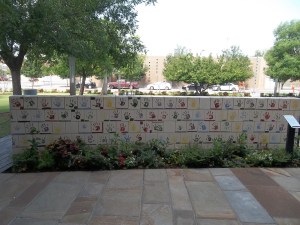
OKC Memorial. Each chair is engraved with the name of someone who died in the bombing. The large ones represent adults; the small ones represent children.


Finally, in the afternoon, news from my husband. He’d heard from his mom. His sister had not been in the building. She was alive. But her best friend died, leaving behind two small children. Several other people she knew perished, as well. I can’t fathom losing several friends and coworkers all on the same day.

I have a confession. The Oklahoma City bombing shook me more than 9/11 did. I’m not sure that’s true for many Americans. Is there a hierarchy of terribleness? I don’t know. Both events sent shock waves through my life. But Oklahoma is in the midwest. It’s not supposed to happen here. I had never been to New York (still haven’t), but had spent considerable time in OKC. I’d seen the Murrah building with my own eyes. Worse, I’ve met people who sounded a lot like Tim McVeigh.

The images flooding the news over the following weeks prompted a river of tears. Into what kind of world was I bringing a child? And how would I ever keep my baby safe? I can still be reduced to a puddle if I think about it much, the knowledge that acts of terrorism can happen close to home. Then there’s the “evil walked among us and we didn’t even know” feeling about the perpetrators.

My family has visited OKC several times in the last two decades, but not until a couple of years ago did we visit the Oklahoma City National Memorial. The word “moving” doesn’t touch the depth of feeling it evokes.

Surviving tree
Somehow this tree survived.
So many chairs. So many lives.
At OKC Memorial
So many.


My sister-in-law pointed out that nobody will ever be able to give an accurate number of lives lost. She told us of an acquaintance who committed suicide several months later in the wake of the trauma. Yet his name isn’t included on the roll of the dead from the bombing.

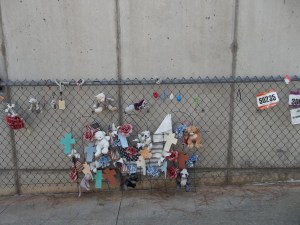
Grief in spray paint


I don’t want to try to imagine what these years would have been like without my sister-in-law. I’m grateful for her always, but it’s often a low-level gratitude. Anniversaries like this bring it vividly to the forefront. My husband’s father died much too young, and his sister, as the oldest child, has worked to be the emotional, and often logistical, support for her siblings and their families. She’s one of those rare people who is so solidly there for everyone.

How about this, y’all? How about we all try to treat each other with love and compassion? How about we try to live together instead of killing each other?


Can We Make Public Schools More Like Public Libraries?

I have worked at a public library for 11 years and been a public school parent for 14. I’ve lost count of the number of times I’ve found myself wishing my kids’ schools could be run a little more like the library. Here are some examples:

1. Truancy. During a handful of years one or both of my kids had several colds and missed more than the “allowed” number of days of school. Whereupon I received an automated shaming letter chastising me for my child’s absences and explaining how important education is. These letters always lead me to thinking about the broader issue of how often school districts and the governments that fund school districts rely on a punitive approach to issues. I understand the concern if a student has excessive absenteeism when they’re not ill. But what will actually help get them in the door? Schools are frantic to have a good head count every day so they get full funding. If they can’t get the kids there in the seats, the district is financially punished. In turn, they punish kids and parents when the kids don’t show up. It’s been my observation that punishment is more likely to lead to dropping out altogether. It’s almost as if the students are there to serve the system instead of the other way around.

Wouldn’t it be worth a try to use some positive measures? When people don’t come to the library, the question isn’t “How do we punish them?” The question is “How can we better serve their needs so they’ll want to be here?” Community surveys are done on a regular basis to discover what residents like about what we’re already doing, what things we could do better and what new services folks might wish for us to provide. Occasionally, we’ve kept what are called “No logs” – listings of every instance where a staff member said “No” to a patron request. After a few weeks, it was easy to see what needs weren’t being filled. Several times a day we were saying “No, we don’t have a fax machine for public use.” Well, after realizing how often people were requesting to use one, we do. Now we can say “Yes, there’s a fax machine you can use.”  Same thing with notary services. And maybe when the person comes in to use our fax machine or get something notarized, they’ll notice a flyer for an upcoming program that catches their fancy. Or they’ll see our DVD collection and say “Oh, I didn’t know you had movies here.” And they’ll come back again. Or not. But at least we’ve found one way to be of service to them.

2. Choices.  At the library, you don’t have to do everything or be good at everything. You can choose how much of the library to do. If you want to come to several programs every week, plus checking out print books, ebooks, audiobooks, DVDs and music CDs, go for it! If you only want to use our downloadable music service from home, that’s fine. My 16-year-old is feeling really done with English at high school and he gets top scores on all assessments. Why does he have to keep taking it? Likewise, there have been classes that caught his interest, but the learning he’d already done in the subject happened outside of the school setting and so he didn’t meet the prerequisite. At the library, if a 6-year-old wants to participate in our Lego program, there’s no prerequisite that they must have attended storytime as a three-year-old. Also, you get to choose which books to read and we don’t scold you that they’re too easy or too hard. You can figure that out for yourself. The library doesn’t have a quota. Read one book per year or 70, we’re here for you. If there’s a book you want and we don’t have it, you can suggest we purchase it. If it’s a new book, published within the past year, there’s a good chance we will. What if students could suggest classes or even just have a say in the curriculum of the classes already offered? Would they be more motivated? More interested? Maybe.

3. Cooperation and sharing. Let’s go back to that book you wanted that the library doesn’t own. If it’s older than about a year, we probably won’t purchase it – BUT. We will try to find a library that owns it and request a loan from them. Libraries borrow from and lend to each other constantly in an effort to make as many resources as possible available to as many people as possible. It’s not unusual for a book to journey hundreds of miles to fill one patron request. With today’s technology I wonder if schools could do something similar. My son has had the experience of signing up for a class that didn’t happen because not enough students enrolled for it. But with Skype and other technologies, it seems to me schools working together could come up with enough students for a class that could meet via technology. Or they could arrange for the three or four students from one school to remotely attend a class happening at a different location.

4. Pacing. My library’s lending period for most materials is three weeks. But if you get finished sooner, you don’t have to wait until the end of that three weeks to start reading or listening to the next thing. And if the three weeks passes but you’re not quite finished, you can renew unless there’s a waiting list for the item. Even then, you can get back in line for it and have more time to finish. At school, you have a set amount of time to do the unit. Finish early? Okay, twiddle your thumbs for a while. Not quite done? Too bad. That was your only chance. (I do realize many individual teachers work with students to remedy this; I’m talking about systemic issues, though.)

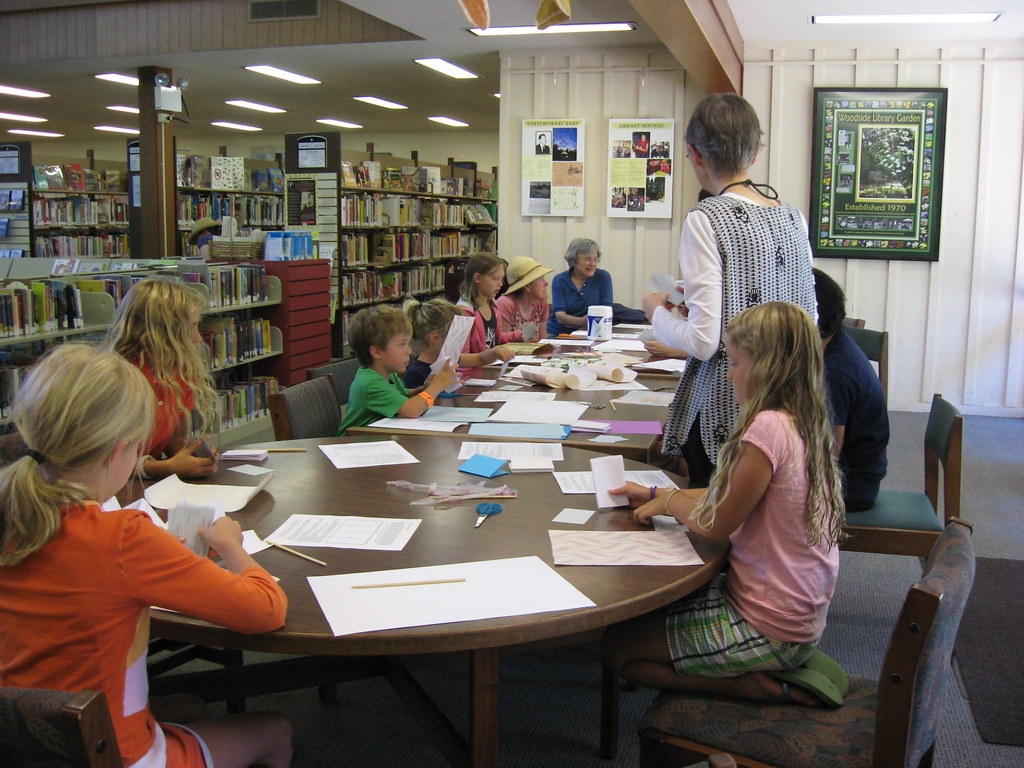
5. Mixing of age groups. One lovely thing about a public library is how it’s for everyone. We might have a 17-year-old and an 80-year-old in the same “How to Sell Online” class. While there are some general common-sense age guidelines – a 3-year-old can come to story time but not sign up for a gardening seminar – there’s a lot of intergenerational mixing, which is good for everyone. If you’re 90 years old and have never used the public library, you’re welcome to start today. Even programs aimed at a certain demographic aren’t as narrowly restricted as grades in school. Our teen programs have 13-year-olds and 17-year-olds.  Siblings can attend together if they have the same interest.

Looking back over my list, what I see at the core is a desire for schools to be more flexible and less punitive. I know change is hard and complicated, and almost always brings with it unforeseen consequences. But I can dream, can’t I?

Every Day for a Year

FullSizeRender

For the past decade or so, I’ve noticed a spate of books and articles in the vein of “The Year of…” fill in the blank. “The Year of Living Biblically.” “The Year of no Internet.” “The Year of Eating Only Locally Grown Foods.” I keep thinking I could write one called “The Year of Doing Nothing Much Special.”

Ah, but 2014 was the year I celebrated my 50th birthday, and I did set myself a goal for the entire twelve months. It wasn’t a hugely transformative change, nothing like learning to make my own clothing from organic cotton and then wearing only things I produced myself, or moving to a cabin in the woods with no electricity or indoor plumbing. My goal was simply walking a minimum amount every day.

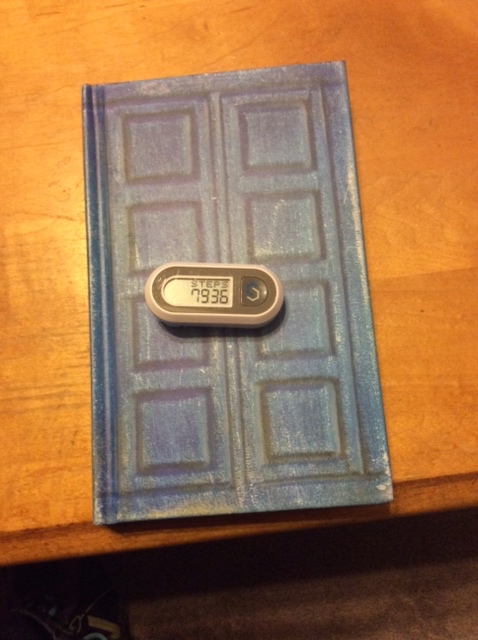
I wanted a number that was meaningful in terms of my age milestone. I wanted to make it attainable and not too overwhelming so that I wouldn’t give up and not do anything at all. With two teens at home, managing things for an elderly parent, plus my day job, my life often resembles a frantic game of Whack-a-Mole. Time is a real issue. And money’s an issue. I can’t commit myself to something if it requires a lot of equipment. But I didn’t want to make it too easy. I wanted to have to make some effort and get enough exercise to benefit my health. I settled on 5,050 steps per day minimum. With my stride length, this works out to about 2 1/4 miles.

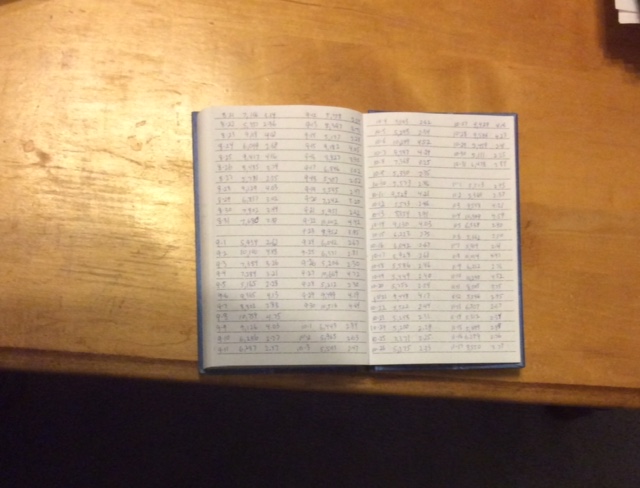
I’ve been writing down my numbers in a little journal, like Rain Man with his notebooks, each night before I go to bed. Date, steps, miles. I’m not sure why I need the documentation, but I have it.To be honest, I figured I’d have a at least a few off days where I didn’t quite make it. But I was wrong, peeps! I’ve met my minimum goal every single day for 365 in a row – January 1 through December 31.

Many days were easy. If I didn’t have to drive my son to school, I could walk to work. And once there, I’m often on my feet. I work split shifts two days a week, which means two round-trips on those days. If I’m able to walk both times, I can break the 10,000 mark without much extra effort. On days when I didn’t work and the weather was terrible (I’m talking ice storm terrible), I found myself doing things like walking in place as I stirred food on the stove. As my 16-year-old observed, “You can get a lot done if you don’t mind embarrassing yourself.” The biggest challenge came in early April when I had a terrible cold. But I made myself move. I’d get up off the couch every half hour or so and walk circles in my house while heating a tea kettle. Then I’d collapse and remain in a heap for another half hour while sipping tea.

I have an old friend who does nothing by half measures. One of his obsessions is physical fitness. As a friend, he’s 95% wonderful and 5% completely annoying. The 5% reveals itself when it comes to the topic of out-of-shape people. He used to be a little chubby himself, and you know how nobody is so fanatical as a convert. Several weeks ago, he posted a rant on Facebook about people using pedometers and how 10,000 steps a day was nothing as far as exercise. 10,000 steps should be a baseline and you had to do something else in addition to walking, he said. I started to respond with something along the lines of “Come live my life for a few months and then we’ll talk.” But then I realized this kind of thing is the reason there’s a “hide this post” option.

Yeah, 5,050 steps isn’t a huge number. But’s not nothing, either. It’s not even next to nothing; it lives in a different neighborhood. Yeah, my weight hovers on the line between what the current medical charts call the “normal range” for my height and what they call “overweight.”  But I had all of my middle-age tests done and got excellent numbers on my report. Cholesterol, triglycerides, blood pressure – all great. My doctor actually used the word “optimal” and said she wished her numbers were as good as mine. So I figure whatever a bathroom scale has to say falls into the “hide this” category along with my friend’s fitness rant.

It feels good to have stuck with it. I find value in making myself  keep going, even when I don’t feel like it, in order to meet a bigger goal. And no matter how little in the mood I am for walking, once I start I always remember that I love it. I love walking. There’s a however coming, though…

However, for 2015, I’m allowing myself an occasional day off. I’m upping my overall minimum steps goal, but measuring it in weekly increments. I plan to count weeks Monday-Sunday. If I have my steps in by Saturday, I can relax for a day. If I’m behind, Sunday is a good day to catch up. My target for the new year is 45,000 steps per week. If I meet it, I will have walked 1,000 miles by the end of the year.

Goodbye 2014. I’m closing the book on you.

IMG_0304

Onward to a new year.


How We Flunked Story Time

may_28_6968_frog_tadpole “Story time saved my sanity.” Thus proclaimed a friend with children much younger than mine. She gushed to me how much her family loves the library, and especially the children’s programs.

This sent my mind into a reminiscence of my own family history. I didn’t reveal to her my shameful secret. But I will confess it here. When my daughter was three and my son a newborn, our family flunked out of story time. At the very library where I now work.

It had to do with the green paper circles. Lily pads you might call them if you were a story time lady presenting a tale about frogs. Or, if you were my then 3-year-old daughter, you might call them wall dots, green steering wheels, round green hats, or frisbees. In her eyes, the possibilities were endless.

“Let’s sit on our lily pads little frogs, while we hear a story!” prompted the cheerful story time lady. 10 or 11 out of the group of 11 or 12 little frogs obediently criss-cross apple sauced on their lily pads.

“Frogs sit *on* their lily pads, not *under* them,” said the story time lady, still cheerfully.

“Mine’s a hat!” said my three-year-old, also cheerfully.

“Okay, well, let’s get the story started,” said the story time lady, gamely.

As the other children were doing the finger plays, my daughter was driving us to the store with the steering wheel that had been so thoughtfully provided. “I’ll drive since you’re holding the baby,” she whispered to me.

“Remember to sit on your lily pads,” prompted the story time lady, a little sternly, as the story ended and she prepared to begin a song. This time she was looking at me, a look that told me I was allowing my kid to Set a Bad Example, and I should begin enforcing the story time rules like a Good Mother.

But she’s not being disruptive, I thought back at her. She only whispered once, right in my ear. If I argue with her, that will be disruptive.

I don’t remember the song, probably something to do with amphibians. I remember I sang along, while wearing a green paper hat, held on my head by my kid. It was only fair that I have a turn, after all. See, I had taught my child about taking turns and sharing. Not a total loser mom, huh?

As a finale, there was a second song. And the kids were allowed more action this time, hopping, a little, in place, on cue. Or in one case, doing a small interpretive dance – The Dance of the Green Circle. My inner being was divided between mortification and fierce pride. I know which side the story time lady came down on, as she threw in an extra demonstration of the proper form of hopping.

As the program ended and parents left hand-in-hand with their children, I saw some other families grouping together, comparing this experience with story times of other weeks. Apparently they had a story time clique. Their offspring had been in training since birth. And here I thought I could bring in my wild child starting at the advanced age of three and have her fit in.

Said child, meanwhile, now that she was allowed to move around and talk freely, was pointing out to me all of the things you could do with a circle of green paper. You could decorate a wall with it. You could tuck in the top of your shirt in back and have a round superhero cape. You could hide your face behind it to play peek-a-boo with a baby. You could use it as a baby blanket. After a minute, my mixed feelings coalesced into amazement at my kid’s mind and attitude – that she could be so excited and could see so many possibilities in circle of paper.

I glanced around at the other families, with their conforming kids, who would have fit right in on that planet in “A Wrinkle in Time” – the one where the children bounced their balls at the exact same time on the exact same schedule every day. Suddenly, they seemed a little, hmmm, soulless might be the word? Those poor moms and dads, seeing the limitations of their merely adequate children exposed in the bright illumination cast by the creative genius shining from my daughter. Yeah, I couldn’t put them through that again.

We’d stick to our informal weekly playgroup and leave the organized story times for those others. I imagined the librarian in charge of the program that day thinking of us as “not story time material.” I suppose some people might look at it as having failed, and at times I have looked at it that way, too, wondering why my kid has such a hard time getting with the program. But I prefer think of it more as not a good fit. See how non-judgmental I’m being about the others’ rigidity and lack of imagination?lilypad

The same dynamic would continue to play out in public school as the years went on. My older kid often had “better” ideas than the teacher about how an assignment should be done. Some teachers loved this and used it to advantage. In those classes, my child learned a lot and accomplished some remarkable creative achievements. Others instructors – I call them lily pad teachers – lived by the philosophy “Rubrick uber alles!” My offspring showed a marked failure to thrive in those classrooms.

I never have completely sorted out my feelings. No, I don’t think the school should have to convert any of their computers from qwerty to Dvorak because one kid think it works better. (Pick your battles, child.) But yes, I do think my then-10th-grader should have been given extra credit instead of a zero on that world history report for having gone so far above and beyond in research and effort, in having a desire to do something that wasn’t a rehash of every other paper that had been written in the same classroom for the past decade.

Eventually the little frog grew strong enough to hop its way out of the public school pond and forge its own path to college, via self-study and a GED. Have I mentioned the college major? – Fisheries and Wildlife. Lack of preschool success at frogdom notwithstanding. I guess it didn’t go on the permanent record.


greencirclegreencirclegreencircle

Poem: Seeds

DSCN1749

Here in the middle of the U.S., we just passed the frost date. So it’s time to plant. Here’s a seasonally-inspired poem I wrote:

Seeds

“Here it is,
The start of my first garden,”
she tells him.
Two dozen flat seeds
the color of milk, round with a point,
pour from a paper packet.

He wants to know what else she plans to plant
other than bell peppers.

She hasn’t decided yet,
but thinks it will be wonderful
to raise her own food.
She’ll cook more from scratch,
maybe even learn to can.
Gardening is great exercise;
she knows she’ll lose weight.
She hopes to figure out that sewing machine
she picked up at a garage sale
to make her own dresses.
Who knows?
She may need maternity clothes soon.
Healthier living should improve their chances.
At least she thinks so.
She wants to know what he thinks.

He thinks it seems like a lot to expect
from one little handful of seeds –
to grow a whole new life.

**

This poem originally appeared in “Mid-America Poetry Review.”

How I’ve Kind of Sort of Taught Myself to Play Piano Just a Little

clases-piano-individuales


“Do you play an instrument?”

When this question comes up in conversation, I usually answer it with “No, not really. Well, sort of. I mean, I’m not good, but I can kind of play piano about this much.” I hold my thumb and forefinger an inch apart to demonstrate how small my musical accomplishment really is.

When I was in grade school I became fascinated with the two pianos in our school – one in the auditorium and one in the music classroom. I remember the day the music teacher let each of us in turn practice a middle C scale. And that’s about all I recall from music class in my elementary years. Mostly, I remember daydreaming about playing the piano in the auditorium when we were stuck in a boring assembly. A couple of times in fifth grade, when my class was supposed to be working on sets for a class play, I snuck over to the piano and started pressing keys simply to hear the sounds. I don’t know why, growing up in a house where Hank Williams was considered a deity, I developed a liking for the sound of the black and white keys. Maybe it was a form of rebellion, since a keyboard is seldom used in country music, or at least not the country music my parents favored.

I’m not claiming to be high-brow in my musical tastes. I like me some pop music. But especially when that pop music heavily features keyboard of some kind: Elton John, Carole King, Stevie Wonder, Bruce Hornsby, Coldplay, Lady Gaga (yes, even though I’m thoroughly ensconced in my middle-aged years; I try to concentrate on the music and not the meat dress or whatever.) I’ve always kind of wished I knew more about music, but didn’t know how to go about learning. My dad had a guitar and a fiddle that he’d picked up used somewhere, and he taught himself to play. But he wasn’t one to let kids mess with his stuff. And paid music lessons in my childhood were as realistic a possibility as a trip to the Antarctic.

I signed up for band class when I went to junior high. I played clarinet because I had to use a school instrument and took what was available. I did learn some about reading music and my ear got trained a little, but let’s just say clarinet was not my destiny. For years I stuck with playing the radio, the daydream of piano hovering in the back of my mind, surfacing occasionally. It wasn’t so much that I felt deprived over it not happening in real life, but that I enjoyed having a fun little fantasy sometimes.

Then my kids came along and my husband’s sister had their childhood piano sitting in her house, unused. The soundboard was slightly cracked, but it would do for the kids to start learning. When my daughter was nine and my son six, we acquired the instrument and I signed my kids up for piano lessons. For the first little bit, I sat in the teacher’s living room, petting her dog, and listening to the instructions she gave the kids.  Following along at home, using the lesson books, I’d practice the same things they were learning. I used to spur the children to practice by pretending to compete with them, saying things like “You don’t want me to get better than you, do you?”

My daughter stuck with lessons for six months, then decided to pursue other interests. But my son – let’s just say piano does seem to be his destiny.  After a couple of years’ time, he’d passed me right up. I couldn’t keep pace with him. When he was 10, my mother-in-law and sister-in-law pooled their money to buy us a new piano, and he was in heaven, using an instrument that sounded the way it was supposed to. By the time he was 11, he was choosing Philip Glass pieces to play in recital. He’s 15 now and not only still plays, but also owns a MIDI keyboard he keeps plugged into the computer so he can compose and record his own original music.

Meanwhile, I’m still plugging along, inch by inch, through children’s lesson books, supplemented with YouTube tutorials. My practice has fallen by the wayside a couple of times, for periods of a few months, but I keep coming back to it. When I say inch by inch, I mean my progress is soooo slow, and by slow I mean think in terms of those drops of pitch that hung suspended for many years before finally falling in that Australian study. For one thing, I can only squeeze in 20 minutes or so of playing, about three or four days a week. After nine years, off and on, I’m finally at the end of the fourth instruction book.

I no longer have any pretense that my playing has anything to do with encouraging or assisting my children in any way. I know I’ll never be good, really, and I have no desire to try to perform for anyone else. My fingerwork is too staccato, and unlike my father and my son, I don’t possess an innate ear for the notes . But I’ve learned more about music, which means I get more out of the music I listen to. Plus, playing an instrument is supposed to help your brain function. My brain will take all the help it can get. And I enjoy it so much, those little 20-minute sessions of daydream fulfillment.

So yeah, I play piano now. Kind of. A little.


Orange is the New Black: Random Thoughts


Black_squarebig-orange-square


Spoilers. You’ve been warned.

So I watched the series I kept hearing about: Orange is the New Black. Now that I’ve finished all available episodes I find myself thinking about the show. A lot. Random thoughts follow.

Am I a prude? Maybe I’m a prude. I found myself blushing a couple of times while watching by myself. I almost turned off the first episode because I felt so uncomfortable with them leaving nothing to the imagination. But I found the story so compelling I kept watching. Maybe I’m a prude.

Finally, a show filled with women who look like the women I see in real life. All ages, races, shapes, haircuts. Annndddd…it’s set in a prison.

But really, in what other context in our society do women of all ages, races and shapes interact quite so much? Could we try to replicate this in real life? Outside of prison?

The show certainly passes the Bechdel test with extra credit. And it’s set in a prison. The flashbacks to the lives of the women, pre-incarceration, are compelling to me. I love how they are painted as neither complete saints nor complete sinners, but complex human beings with a mix of choices and luck.

Speaking of which, when the young guard says to Piper that she could be one of them if things had happened differently, is she just being empathetic and trying not to judge? Or does she have a past? Hmmm.

Interesting how the show sets it up to make it seem that Piper is the most well-read, book-smart inmate. Then over time, you come to see Taystee really is. She’s come to be my favorite character, not least for the scene in which she refuses to let the short woman check out “Harry Potter and the Goblet of Fire” from the prison library because she’s afraid it will be used as a step-stool. I love how Taystee hands her a copy of “Ulysses” instead, along with a literary critique.

Class issues. I’m going to talk about Taystee again. Who else’s heart broke when Taystee got out and then had no place to live? I think this show does a lot to show your economic class can have a big impact on your likelihood of ending up in prison, largely because there are no good choices available to be made. And because money buys legal representation.

Who wins the award for prisoner with the guiltiest conscience? I think it’s the yoga lady.

What does the warden look like? Will we ever see him?

Mr. Healy is the worst. The. Worst. THE WORST. I chuckled over the scene where he had Red interpreting for him and his Russian bride. But he’s still THE WORST. Earlier I thought it was Pornstache, but it’s Healy.

Funny how I’ve gotten this far into writing down my thoughts without mentioning the Alex/Piper relationship. I guess I don’t find it as interesting as some of the other things going on in the show. But you can really see how they both used the each other.

From now on, whenever I mention anyone I know on my blog, or anything from my personal life on my blog, I’m going to worry that I’m channeling Larry, Piper’s fiance. Her imprisonment sure has jump-started his career, hasn’t it?

Laverne Cox! How wonderful to have a trans actor play a trans character. I adore how accepting the nun is of her life and how they strike up a kind of friendship.

Crazy Eyes – What a great scene when her parents come to visit and you find out they’re white. My heart actually hurt a little when she asked Piper why people call her Crazy Eyes.

For all that she’s lethally dangerous, Pennsatucky deserves treatment for her mental illness. What if she’d received real mental health services? I mean, seeing her back story, she should definitely be kept out of society. But her delusions have only been encouraged. Wouldn’t everyone, including her, be safer if she got true help?

Is Piper losing her mind? Was the voice she heard in solitary real? Did she actually see that chicken? How badly did she hurt Pennsatucky in the final fight scene? My favorite line of hers in the series is when she tells her mom that the reason she’s in prison is because she’s no different than anyone else in there.

Finally, near the end, they had some new women in wearing their newbie jumpsuits. Was one of them a girl who had been in for the scared straight program? Or did I imagine it?

Shows With a Strong Female Lead

janeway   LizLemon    RosemaryThyme     VicarDibley


Oh hey, Netflix does know what I like. “Shows with a strong female lead” is now one of the categories it offers to me. Interesting I should notice this tonight, after reading an article today documenting the dearth of women in contemporary movies. I suppose I have been tending toward the strong female leads lately, given a wide variety of choices.

My husband and I lived without a television for many years, at his request.  But now we are TV owners and get most of our shows through Netflix instant streaming. (We don’t actually have a cable package and I don’t see one in our near future.) There is a gender divide when it comes to watching habits in my household. My husband and 15-year-old son watch something on rare occasions; my 18-year-old daughter and I are the main viewers.

I’m catching up on stuff I missed over the years. So much Star Trek! I watched Next Generation and Deep Space Nine – all of the episodes. Then, without noticing it, I started a series of series with women at the fore: Thirty Rock, Star Trek Voyager, a British mysteries series called Rosemary and Thyme. Currently my daughter and I have a standing Thursday evening date to watch Vicar of Dibley, starring the very funny Dawn French.

I remember some shows I used to watch when I was a kid. For a while my brother and I sat glued to reruns of The Wild Wild West after school almost every day. Or maybe only I was glued, but I recall him being there. I loved tracking the exploits of two undercover agents in the old west. They employed clever disguises and even cleverer technological gizmos. I used to pretend to have adventures with James West and Artemus Gordon. I’d help them recover the stolen treasure. I’d disguise myself as a sheriff or a poker player or whatever the situation called for. Together we’d outsmart the villain. Often, the two heroes required rescuing by me. I made my mom nervous as many of these games involved climbing around in the trees in our back yard, to the highest branch I could reach.

I managed to overlook the typical women’s roles in the show, which were, as I recall, to look pretty, wave a fan while batting eyelashes, fall in love with the agents, get held hostage, and things along those lines. Then one day I could ignore it no more. I came home, settled in with my snack, and turned on the tube, eager to see what my heros were up to that afternoon.  To my short-lived delight, the two leads fell in with a woman who was their match. She dressed in practical clothing that allowed her to move through action scenes. She shot guns. She did everything the guys did – everything I did in the stories I made up. It was thrilling. So thrilling! Right up until the gentleman solved the “problem” of her behavior by getting a proper woman to convince the strong female lead how delightful it would be to put her energy into wearing frills and make-up instead doing all that tiresome actiony stuff. I still get a bad feeling in the pit of my stomach when I think of the final scene, where my two ersatz partners in daydream adventure grinned at each other with self-satisfied smirks over the two women giggling in the background, the tomboy having been shown her place. I watched a few more episodes after that, but any enjoyment on my part was half-hearted. No longer could I gloss over how people of my gender were portrayed and treated. No longer could I fail to acknowledge the lack of any place for a girl in these adventures.

I’d like to be able to look back and say, “What was it with that one show anyway?” But it wasn’t only The Wild Wild West. I had the same experience multiple times. Starsky and Hutch. Let’s talk about them, shall we? I didn’t have quite the attachment to these two buds as I did to the West/Gordon duo, but I liked the show pretty well. They engaged in entertaining banter sometimes and besides, all the kids at school watched it, so I needed to be in the know or be left out of conversations.

I was a little older and a little more skeptical. Already, I had to work to suspend my disbelief over some of the plots. “You’re going undercover as a hair stylist? Really? You can do that without the months of training that hair stylists go through? Gonna just pick up a pair of scissors and start snipping?” I may have rolled my eyes, but I continued to tune in. Until the episode with the reporter.

A female reporter arranged to shadow Starsky and Hutch so she could write a feature on them. Did I forget to mention? An attractive female reporter. The two police officers proceeded to act a lot like some of the sixth-grade boys in my class at school, trying to impress the girl by being jerks. As the story unfolded I found myself thinking the two cops should be glad I wasn’t the reporter, because I’d write something pretty scathing. As it turned out, the reporter wrote a pretty scathing piece about them and their not really cool or constitutional antics. Ha! I laughed, figuring they were going to see what they really looked like to others and mend their ways. Yeah, not so much. They got angry. And then they got even by more or less kidnapping the reporter and acting like even bigger, more unconstitutional jerks, to show her. And she learned her lesson. Properly chastened, she wrote a retraction of her previous article, explaining how the two men were true heroes, something her tiny brain had been unable to grasp at first. I never watched another episode after that. Ever. To this day.

Properly chastened – this was the most galling part to me. It was bad enough that the male leads thought the women needed to be put in their places and treated them accordingly. The worst thing was how meekly the women accepted it. With humility, they came to realize and admit they had no business trying to do the same things men did, nor any right to criticize a man’s actions, especially not a male authority figure. And Starsky and Hutch were supposed to be rebel cops – hmph!

But wait, there’s more! Off the top of my head, I can come up with two more shows in which women’s roles were mansplained in ways that caused female characters to see the light. The Courtship of Eddy’s Father and My Three Sons both broadcast episodes with such edifying storylines. And don’t even get me started on the number of times I saw this scene repeated: Female guest star is being all female and hysterical, because she’s got it in her head that people should listen to her or something. So male lead grabs her and kisses her. She resists, but he doesn’t stop! Until she melts into his arms, because all she needed to be soothed out of her irrationality was to be force-kissed. My dad wasn’t anything resembling a feminist, but I’m pretty sure his view on someone kissing me against my will was that I should punch the guy if I could.

So now I have access to shows with strong female leads and I say “Yes, please!” Give me Captain Janeway, in charge all on her own, nobody having her back. No Starfleet Command available for consultation or reinforcement. Making all of the tough decisions and taking all of the consequences. Give me Voyager, which passed the Bechdel Test as a matter of routine. Give me scenes of three female crew members putting their heads together to fix a problem with the starship’s engine.

Give me Liz Lemon on 30 Rock, supervising a crew of eccentrics and somehow getting them all to do their jobs. Give me a female character who loves to eat as much as I love to eat and who is not apologetic about it. One who is truly flummoxed when forced to choose, at the airport gate, between the man she loves and the sandwich she loves.

Give me Rosemary Boxer and Laura Thyme, two middle-aged women who run their own gardening business and solve murder mysteries on the side, who dress in actual gardening clothes, duck boots and all. Their hair comes all unkempt and they get dirty. Plus they’re smart enough and brave enough to catch the criminals.

Give me a small English village’s first female vicar, one who can hold her own with the moneyed town councilor who is used to getting his way. One who is wise and caring and fallible and funny. One who is a strong female lead. Thanks for the category, Netflix.

Notes on Scraps of Paper

Often inspiration for a story or poem strikes when I’m in the middle of something else. My paying job, for instance. I have a habit of scribbling quick notes on scraps of paper, hoping I’ll remember the entire thought later. Sometimes I make notes on a book I’m reading. Sometimes I forget these notes until I rediscover the scrap of paper many weeks or months later. Maybe in the pocket of a pair of pants I haven’t worn in a while, to give a real example.

Here are some notes I just found in my own handwriting. It’s a list (?) on one sheet:

character identification

takes place night

extreme close up on eye

music

clothing – a.p. – true

horror lies in sympathy

What does it all mean? Your guess is as good as mine.