My November Word Count

6,207. I said it in my previous post, and I think I’ll have to adopt it as my motto: “No sneering, NaNoWriMo participants. I’m a busy woman.”

I know many of you cranked out 50,000 words this past month. Yay for you! I mean that; it’s not sarcastic. Or bitter. Really. No, really, I mean it. I’m impressed. Maybe some year it’ll be me.

Knowing I would have next to no time in November (day job at which I worked extra hours in early November, one homeschooling kid, one public schooled kid who has auditory processing difficulties and thus requires a fair amount of parental involvement to keep track of what’s going on, providing driving lessons to the older child who has a permit but no license yet, taking one of the kids to physical therapy appointments, taking the other kid to orthodontic appointments, assisting with the running of a writers’ conference, oh and a fabulous week-long vacation in Florida, which required planning and packing for and unpacking from) there was no way I could do NaNo. I regret nothing, especially not the vacation.

Still, I tried to absorb inspiration from all the dedication wafting around in my writerly circles. I decided to make an effort to write every day, even if I only had ten minutes, and keep track of my word count.  This went okay until vacation, when I dropped the ball (or quill or something) and didn’t pick it back up for ten days.

I have written a bit of a novel. I also counted blog posts, both personal and work-related. Add in a couple of other miscellaneous forays into the brain-ink continuum and my 20 total days of writing resulted in 6,207 words. One of those days, I managed five minutes for a word count of 76.

Thing is, though, I can keep this up year-round, and accomplish a respectable amount, all things considered. For now, I accept my lot as a plodding SoMisWriYe (Solitary Miscellaneous Writing Year) tortoise amongst the crowd of NaNo hares.

Eventually, I might join the race. Or I might not.
And to  think, I could have spent that time at a desk, subsisting on coffee and toast crusts, hunched over a computer, frantically typing until my fingers bled. Awww…too bad for me.

My First Novel: a Love Story

When I say love story, I’m not talking about the plot. I’m speaking of the relationship between me and my book.

I finished writing the first draft of my first novel a two years ago. A couple of people read and offered me their thoughts. I have done a couple of revisions. I’ve sent it out a few places and been rejected.

Now, I’m meeting with a novel-writing group and having my manuscript read by more people, who are giving quite helpful feedback. Hearing their comments, I’ve come to see the strengths and weaknesses I display should have been predictable. I’ve spent countless hours of my life immersed in poetry. In more recent years, I’ve produced a number of short stories. My strengths in my first novel, according to my first and second responders, are in dialogue, description and character development. I have many individual wonderful scenes with great dialogue. But it’s obvious this is the first time I’ve plotted something this size. I need to work on the story arc.

I’m trying to decide whether to do another rewrite and work on getting this volume published or whether to let it be and move on. I already have a start on my second novel. I’m about 5,000 words in at the moment. (No sneering at me, please, NaNoWriMo people. I’m a busy woman.)

The other night, while I was pondering my options regarding my firstborn book, I had a happy epiphany. I possess a very healthy emotional relationship with this novel. Whether I do any more revisions, whether I ever publish it or not, I’m so happy to have written it. It’s a story I needed to tell and I’ve told it, if only to a handful of my closest fellow-writers and my spouse. I’m not staking my entire self-concept as a writer on getting it published. I’ve gained some publication credits with several poems and a small handful of short stories. I’ve even been paid some of those times. I learned a lot in the first-novel process and my second book is benefitting already.

See, I don’t have a co-dependent thing going. But I do have a deep, true, abiding love. I’m able to see my novel’s flaws and still care for it – warty story arc and all.  I love my characters. I love my sense of accomplishment in having finished an entire book. I love how much I learned. No matter what I do with my writing in the future, no matter how many books I finish, I will never forget you, first novel. You will always have a special place in my heart.

Veteran, Author – Kurt Vonnegut

“The nicest veterans in Schenectady, I thought, the kindest and funniest ones, the ones who hated war the most, were the ones who’d really fought.” – Kurt Vonnegut

One of my favorite authors, Kurt Vonnegut, was born on Armistice Day in 1922. His experiences as a soldier and POW in World War II influenced much of his writing, especially his novel Slaughterhouse Five, published in 1969. Slaughterhouse Number 5, Dresden, was Vonnegut’s address after he was captured by German soldiers. As a prisoner of war, he was held in the basement of a slaughterhouse, which ironically ensured his survival during the firebombing of Dresden.

Slaughterhouse Five is a novel I feel the need to re-read every few years. I believe Vonnegut’s ability to use time travel and aliens to show his readers absurd truths about real wars showed true genius. I will never forget the image of a soldier trudging for hours through the snow in shoes that are tearing his feet apart.

Happy birthday, Kurt! I know in some version of reality, you can hop in your time machine and come to 2011 to read this blog post.


Bronx Zoo Cobra Revisited

Remember the Bronx Zoo Cobra. I almost didn’t until I was looking through one of my notebooks and found a poem I wrote about it at the time. I figured I’d better go ahead and share before nobody can remember what I’m talking about.


Bronx Zoo Cobra

Snake on the lam
America’s most wanted animal
The hooded Houdini of hiss
Slithered its way out of sight
And into mind
Who would have guessed
A poor humble immigrant serpent
Would become an asp of such ascendance
Climbing to heights of fame
Undreamt since the days
Of Cleopatra


Now it occurs to me this is the second snake-themed poem I’ve put on my blog. I don’t know if it means anything.

R.I.P. William Sleator

Singular author William Sleator  has passed away.

As a teen I read and re-read and re-read certain books. One of those was “House of Stairs” by William Sleator. It’s a science fictionish tale of a group of teens who are subjects in a behavior modification experiment. This book, for me, encapsulates one the most fascinating aspects of science fiction/fantasy. It explores the  question of how people will behave in unusual, even unprecedented situations.

I think this is why I tend to prefer “soft” science fiction. For me, the draw is not technology, it’s people. I love Ursula K. LeGuin for her anthropological approach. Ray Bradbury is another favorite in this area. I know some people are dismissive of genre fiction as “not serious” or something, and William Sleator was double-labeled, because he was also considered a young adult author. But I’ve read widely and eclectically throughout my life, and in my opinion, if you want fiction that explores the human psyche, you could do worse than picking up a book by Sleator.

Hmm…maybe it’s time for another reading of “House of Stairs.” I haven’t visited it in years.

The Anxiety Dreams of Writers

Right now I have 21 pieces of work – 4 stories and 17 poems – out for consideration. I know responses tend not to come in the summertime, so I’m bracing myself for rejections piling up like autumn leaves in two to three months.  Last night, I dreamed they all came at once. Every single submission was rejected on the same day, but it was all in one form. Sort of like the common application for colleges, I suppose, except there weren’t even multiple copies. It was one sheet listing everything I’d sent out everywhere and next to each entry was a red rubber stamp with the word “REJECTED” in all caps.

I woke up and mused on the fact that my unconscious has not yet adapted to the reality of most rejections happening by email now.


Joplin Tornado Relief: Writers Can Help

“The Joplin (MO) Writers’ Guild, in coordination with the Missouri Writers’ Guild, is seeking fiction, non-fiction and poetry to be included in an anthology, Storm Country, to be published near the end of the summer. All proceeds from book sales will go to the purchase of books for school libraries damaged or destroyed by the May 22nd tornado. Midwest writers are encouraged to submit their original work June 1st through July 15th.”

See http://www.missouriwritersguild.org/ for guidelines.

Dear Maeve Binchy

Dear Maeve Binchy,

Upon reading the first couple of chapters of Minding Frankie, I feel compelled to stage a a dialogue intervention.

Americans do not “take posts.” We “get jobs.”

Also we do not “fancy” anyone. We might “like” someone, or “like like” someone, or one of us might be “in love with” someone, or be “hot for” someone. But we don’t send emails talking about “fancying” another person.

You’re great at the relationship between characters stuff, but  perhaps you should get some help for your American dialect problem.

That’s all for now.

That one passage in a novel


    I felt the starched walls
of a pink cotton penitentiary
closing in on me.

*********

Novels are long and have plots and story arcs and subplots and things. But sometimes one single sentence or passage from a novel will stick with me for years.

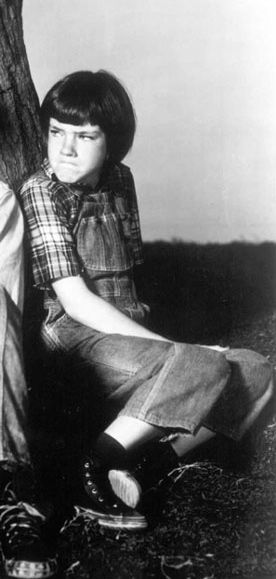
Sometimes it’s because the language is poetic. In To Kill a Mockingbird, when Scout Finch’s aunt comes to stay, she tries to turn Scout into a little lady. Scout explains her situation thus: “I felt the starched walls of a pink cotton penitentiary closing in on me.” As a lifelong tomboy, this sentence speaks to me loud and clear.

Other times I’ll remember a passage that made me think about the universe in a new way. At one point in my life, my favorite book was Harriet the Spy by Louise Fitzhugh. I’ll never forget the nanny, Old Golly, proclaiming “There are as many ways to live as there are people in the world.”

A few years later I discovered Ursula K. Le Guin’s The Left Hand of Darkness, a book that remains on my favorites list to this day. It not only shook up my thinking on gender, but also on political boundaries, when one of the characters asks a not-so-simple question:
“How does one hate a country, or love one? Tibe talks about it; I lack the trick of it. I know people, I know towns, farms, hills and rivers and rocks, I know how the sun at sunset in autumn falls on the side of a certain plowland in the hills; but what is the sense of giving a boundary to all that, of giving it a name and ceasing to love where the name ceases to apply?”

Finally, I have to admit I’m a sucker for scenes where a character quotes Shakespeare and pulls it off. I like this especially when it comes from an Average Joe type character, such Barnaby Gaitlin in Patchwork Planet by Ann Tyler. Barnaby goes through a bit of character development during the course of the story. Without giving spoilers for anyone who hasn’t read the book, there’s a scene where he recalls one poem he learned in school that he understood, a Shakespearean sonnet. He turns to another character, saying “Haply I think on thee.” You’d never predict the words coming from his mouth early in the book, but it so works by the time he says it.

Yeah, novels are long and there are big things in them: plots, story arcs and so on. But attention to detail is still important. Paying attention to getting the right words in the right order at the right place. It matters.

Poem of the Day, April 5

So far, I’m meeting my goal of writing a poem a day. Okay, I haven’t put any words down yet today, but they’re percolating. I’ll have them written before bed.

Here’s yesterday’s poem.  It’ll likely be rewritten a few times.


Geography by Disaster

Fukushima, Chernobyl
Geography learned by disaster
I look at an atlas
When people die
When buildings collapse
When leaders shoot their citizens
In the streets
When the fallout might land here

In tonight’s news I’d like to hear
About a place where today
Tulips bloomed
Fish swam in clean water
Families hiked
Women and men went to jobs
While children learned math
And have this continuation
Of life be amazement enough
To capture my attention