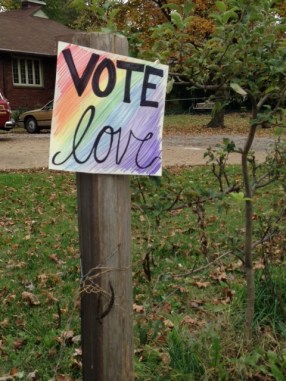
When the Refugees Came, or Why I Can’t Seem to Keep My Mouth Shut on Facebook

Memory from my childhood: I was about twelve years old, returning pop bottles for the deposits at a Safeway grocery store three blocks from my house in Kansas City. A wrinkled woman, not more than five feet tall, wearing a headscarf and a coat too heavy for the weather — probably someone’s grandmother — wheeled her cart toward the check-out lines. She had quite a bit of food.  I guessed she was shopping for the extended family.

The store was busy, lines at every register. I don’t remember what day of the week it was, but Saturday seems likely. I saw the woman stand still for a couple of minutes, scanning the scene, assessing the lines and then spotting one that was miraculously short. She rolled up to it and began unloading her cart of goods right under the sign that read “Express Lane. 12 items or less.” Continue reading “When the Refugees Came, or Why I Can’t Seem to Keep My Mouth Shut on Facebook”

Tree Envy – Poem

Leaf

Tree Envy

Instead of dreary gray strands
threading subtly widening paths
around my head,
I want blazing red
for my autumn color,
interspersed with patches of
can’t-peel-your-eyes away yellow
and clusters
of an orange so perfectly sun-toasted
it holds its own as an independent hue,
not remotely a blend of the other two.
I want the colors to burst
out all at once,
so that people I meet
will feel a catch of breath
at the splendor,
the glorious culmination of my maturity.

Playing Ball

In honor of the baseball post-season and the fact that my hometown team, the Kansas City Royals, gets the award for most improved in the last few years, here’s a post about baseball. It’s a short memoir piece I wrote a couple of years ago. It originally appeared in Ducts.org.

Kauffman Stadium

Playing Ball

I’m five years old and there’s a baseball game in progress right outside my door. We live at the junction of Thompson and Askew. Our corner serves as home plate. The pitcher stands in the middle of the intersection. Very few cars drive by during a summer day in the neighborhood that Kansas City forgot. If a family owns a car, it means the father has a job, and the car is at work with him.

I watch the action from my front yard. Trudy, a teenager from down the street, invites me into the game. She asks if I’d like to take her turn at bat. She’ll help me. I hustle to the corner and take the unwieldy wooden club. I’m big for my age, but not enough to handle an adult-sized baseball bat. Trudy puts her arms around me, providing extra hands to hold the bat steady. Her long, wavy hair falls over my left shoulder. Continue reading “Playing Ball”

A Safe Place You Can Take With You

I recently re-read Neil Gaiman’s book, “The Ocean at the End of the Lane.” It’s a quick and thrilling read. The narrator, an unnamed man now in his forties, comes home for a funeral and revisits the family who lived down at the end of the lane from his childhood home. While there, he recalls events from the year he was seven. The happenings included encounters with powerful and sometimes terrifying creatures.
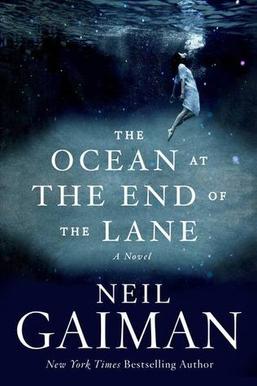
Avid readers will identify with the protagonist when he says, “I went away in my head, into a book. That was where I went whenever real life was too hard or too inflexible.”

Without giving too many spoilers, I’ll stick with saying his situation gets to the point where even his home and family aren’t safe for him. But he still has his books. He reads about Narnia. He reads his mother’s old books about teenage girl heroines who save their country in World War II. He takes refuge with Dick Whittington and his cat. Here’s the really brilliant part. When he’s in danger and can’t get to a book, he keeps himself together by thinking about books he’s read. They’re still with him in his head. It’s even what he says. The safe place is in his head; books get him there.

This struck me because there have been a number of times in my life where no place felt secure, or when I was in a fraught situation where I couldn’t physically leave. But I could read. Whether I was visiting with literary characters who were experiencing the same things I was and thus made me feel less alone, or going on an incredible adventure completely removed from my corporeal life, I could take mental flight through books. Like the boy in Gaiman’s book, I discovered I could create a safe space in my head. I can carry my safe space with me. It’s a pretty good coping strategy. Honestly, I don’t know how non-readers survive.

Let’s Hear a Ringy-Dingy for Emma Nutt and Lily Tomlin

Happy Emma Nutt Day! On September 1, 1878, Emma Nutt opened a whole new profession to women by becoming the first female telephone operator. She remained at her job with the Edwin Holmes Telephone Dispatch Company for more than thirty years.

September 1 also happens to be the birthday of Lily Tomlin, aka Ernestine of the telephone company. Coincidence? Or is there a cosmic order at play here?

https://youtu.be/SvesMBkduQo

Even those of the younger generations who didn’t experience the days of a telephone monopoly and don’t quite get the deal with long-distance calls will see that not everything has changed when it comes to phone companies.

Steps Mania

These shoes were made for walking.

I’ve wanted a pedometer ever since I discovered such a thing existed. I’ve always been in love with walking. I’m not simply caught up in a current trend. For some reason I want people to know this, to know walking was my medicine for many years before theFitBit was even a glint in the eye of a product designer.

When I was a teenager with no money and no car, living in an often stressful situation, my escape was a stroll to the public library, a little over a mile from my house. The library was a haven, but the walk there was also an essential therapy element for me.

When you travel by car, you miss seeing fairy houses up close.

Back in my early adult years, before children, I engaged in a lot of physical activity. I bicycled every day, including a stint where I pedaled to work and back, five miles each way. I hung out with a group of footbag (hacky sack) players and had the luxury to spend a few hours every week kicking. I even competed in tournaments. Oh, the calories I burned. But given my choice of a vacation activity, I’d tend to choose some place with lots of hiking trails. Then, too, I’ve generally been more than willing to walk for transportation given the time to do so.

Once I had kids, opportunities for my own recreational activities became scarcer and exercise something I had to strategize to work into my daily life. Walking was the activity that fit most seamlessly. Put the child in a stroller — oh wait, firstborn screamed when pushed in a stroller. Reconnoiter, buy a baby sling, tuck in the infant, and take off. Much better. When the weather was bad, sometimes I’d go to the shopping mall and experience a reframing of my regard for mall walkers, as I perambulated up and down halls for twenty or thirty minutes. I liked to maintain a self-concept that included the word “tough.” This included a willingness to trek outside through any kind of weather. Mall walking didn’t fit. With the advent of motherhood, my self-concept had to lean more heavily toward adaptable.

A couple of years ago, I finally got a pedometer. And so did everyone else. I had my own personal goals, molded to my life circumstances: kids at home, job, responsibilities for my mom (though I’m happy to do it, it’s often like having a second job), an extremely needy old house. For the first while I could go cheerfully about my walking business with only a vague awareness that others were tracking their steps as well. Then people started talking about their steps. And getting competitive about their steps. And some of them got judgy about other folks’ daily totals, maintaining a haughtiness over how much higher their own test scores pedometer tallies were.

The only way to get to this spot is on foot. Elephant Rocks State Park, Missouri.

I had this lovely thing, this activity that had helped me cope in my worst times, a cherished prize that served as a beautiful centerpiece for my life and was an integral part of my identity. And everyone was RUINING it. Turning it into a tawdry game of one upsmanship. Also, some of their reported counts seemed a little out there to me. Someone who has a yard no larger than mine somehow would get 25% more steps than I did while mowing. Hmmmm.

I became suspicious about variations in devices. I admit I have a cheap-ass pedometer. It counts only steps and miles, but that’s all I need. If I take a walk around the neighborhood, it gives me a fairly accurate distance. But it doesn’t always pick up the random two or three steps here or there. If I stop at a shelf in the grocery store, for example, and then take four paces down the aisle, where I once again linger making price comparisons, it won’t record any steps. I pretty much have to take ten or more steps before it believes I’ve made enough of a commitment to movement for it to count. Eventually, one of my friends mentioned her FitBit recorded 400 steps for her while she was riding in a car. Ha! Vindication for my theory. It seemed a little like clothing sizes to me. The more expensive the brand, the more favorable the number. Pay them enough dough and they’ll stroke your ego.

I did some research and found this post from someone who had done her own comparison tests of different fitness trackers. The entire thing is worth a read. However, condensed version: The author, Lindsay Ross, wore many different pedometers at the same time and got wildly varying results. One recorded fewer than 9,000 steps for the day, while another gave her more than 16,000 for the same time period.

I suppose I could have used those couple of minutes to add more steps instead of stopping to enjoy this butterfly.

The money quote for me came in her conclusion:

“But at the end of the day, I don’t think it really matters as long as each individual pedometer is consistent with itself. The entire goal of wearing a pedometer is to get people to MOVE. So as long as the pedometer I choose to wear consistently tracks my movement from day-to-day, and inspires me to move more, it’s doing its job. Whether that pedometer says 8990 steps or 13566 steps, if I MOVE MORE from day-to-day, it’s technically done its job.” 

I’m pretty sure this is a metaphor for all of life, somehow. Don’t compare yourself so much with others; you’re not going to get an accurate gage on that anyway. For some people, getting out of bed is more than they did yesterday. It’s progress. Stick to keeping an eye on your own self, your own goals and achievements.

I intend to focus on enjoying the process. While waiting for the next fad to sweep the dilettantes out of my path.

Looking My Age

Since we’re all pondering the passing of time tonight, here’s a poem I wrote about aging, followed by some musings.

**

The Grottos of My Face

Lines I expected, around
the eyes and mouth, a deepening, settling
in of my features. This is how I aged
in my mind, at twenty, when I thought of aging
which wasn’t often, but enough
so that the image held fast, is there still
decades later, when I hit the snooze
each morning, until the second alarm
propels me through the shower
to the mirror, comb in hand. The third alarm
is the surprise that meets me there
new every day: the grottos
of my face, the shifting of the landscape.
No steady etching, as from
the river time is supposed
to be, according to the poets I’ve read.
Now I begin to see that age
is not a settling but an upheaval
unpredictable,  seismic.

**

2000px-aztec_calendar-svg

For most of my adult life, my appearance has been deceiving. I’ve looked younger than my actual age. Once, when I was in my early twenties, I was checking out books about writing from the library and the lady behind the desk asked “Are you hoping to be a writer when you grow up?” Umm.

I got ID-checked for 21-and-over activities right up to about age 40. But after age 45 or so, it the years started catching up with me and it seemed I could tell a difference in the mirror from one day to the next. I remember the morning I woke up with jowls. It was like having one of those tricky balloon mortgages where people float along complacent for years and years with their manageable payments, until suddenly one day – boom – they owe tens of thousands of dollars all at once.

I’m 51 years old now and I look it. I have a couple of gray streaks in my hair. I don’t plan to dye it, as I know myself too well to entertain the idea I’d ever keep up with it. Besides, I like gray hair, and the shade of gray I’m getting goes well with my blue eyes. I have creases in my face and the newest development is turkey neck.

I tell myself I’m okay with it. There’s nothing wrong with looking my age or being my age. As Sarah Silverman put it, about people mocking her for being “old”:  “I feel like your joke is that I’m still alive. My crime is not dying.”

For the most part, I don’t think about it much. I’d be lying if I said I feel like I have as much energy as I did fifteen years ago. Yet, I have hung drywall in the not-too-distant past. I’m not exactly decrepit. Also, I haven’t even gone through menopause. That’s right — my husband and I still have to be watchful not to pull the old Abraham and Sarah routine and produce an infant in our twilight years.

There are times I let it bother me, and those times generally hang upon the words of someone else. Those times I worry that I look even older than my age. (Though, what would be wrong with that?) Then I wonder if it’s because we have constructed such an artificial idea of what aging looks like in our society. Do I really look older than 51, or is it that people have no concept of what an undyed, undisguised, unreconstructed 51-year-old looks like?

You know how to make a woman feel old and feel bad about it? Patronizingly call her “young lady.” This happened to me twice recently. The first time it was a waiter, and he looked to be quite a bit younger than I, so I’m going to forgive him and allow that he has time to learn the error of his ways.

The second instance was a grocery store clerk, who appeared to me to be around ten years my senior. He not only greeted me with a hearty “How are you today, Young Lady?” (emphasis not mine), but he also instructed the bagger not to fill my bags too full because they would hard for me to lift and asked if I had anyone at home to help me unload them. Good grief. I know I was short on sleep that day, but did I really appear a full 100 years older than my actual age? I overruled him on the bagging, telling the woman she could fill them pretty full because my canvas totes are sturdy. Then I answered his question, “No everyone else is at work or school right now, but I’ve recently been hanging drywall, so I think I can handle a few sacks of groceries.” Either I put him in his place or he assumed my visions of hanging drywall were a product of my senile mind.

I nearly turned around as I was pushing my cart away. It occurred to me to tell him, “Those tampons I just bought? They’re for me. I still ovulate.” I stopped myself, though.

As a girl, I always responded to assumptions about what girls couldn’t or shouldn’t do with a “challenge accepted” attitude. This girl climbed trees higher than the boys did. This girl loved math classes and not so much home economics. This girl was simply herself, whether or not it fit the social narrative or was considered feminine. I want to hold onto her when it comes to age. I want be the woman in her fifties who is okay with being in her fifties. Instead of trying to pass for younger, I want fifty and then sixty and seventy, and beyond to be acceptable and not narrowly defined.

If I ever do dye my hair, I’m pretty sure it will be purple.


Oklahoma City 20 Years Later

Where were you when…?100_0699


On the morning of April 19, 1995, I was at work at an office job when I overheard colleagues talking about a bombing somewhere. I was slightly more than 8 months pregnant with my first child. 450 miles away, my sister-in-law was at home, taking a personal day off from her job in the Murrah Federal Building.

Neither my husband nor I knew she hadn’t gone in that day. We had no cell phones. Phone lines were jammed; we couldn’t reach anyone in Oklahoma. There was email, but it was accessed through dial-up connections – same problem.

As everyone in my building listened to their different news sources and conferred back about the latest, the pit of despair began to seem bottomless. A daycare in the building? I put my hand on my belly, feeling my baby kick, willing the report to be wrong.

At OKC Memorial
At OKC Memorial
At OKC Memorial
OKC Memorial. Each chair is engraved with the name of someone who died in the bombing. The large ones represent adults; the small ones represent children.


Finally, in the afternoon, news from my husband. He’d heard from his mom. His sister had not been in the building. She was alive. But her best friend died, leaving behind two small children. Several other people she knew perished, as well. I can’t fathom losing several friends and coworkers all on the same day.

I have a confession. The Oklahoma City bombing shook me more than 9/11 did. I’m not sure that’s true for many Americans. Is there a hierarchy of terribleness? I don’t know. Both events sent shock waves through my life. But Oklahoma is in the midwest. It’s not supposed to happen here. I had never been to New York (still haven’t), but had spent considerable time in OKC. I’d seen the Murrah building with my own eyes. Worse, I’ve met people who sounded a lot like Tim McVeigh.

The images flooding the news over the following weeks prompted a river of tears. Into what kind of world was I bringing a child? And how would I ever keep my baby safe? I can still be reduced to a puddle if I think about it much, the knowledge that acts of terrorism can happen close to home. Then there’s the “evil walked among us and we didn’t even know” feeling about the perpetrators.

My family has visited OKC several times in the last two decades, but not until a couple of years ago did we visit the Oklahoma City National Memorial. The word “moving” doesn’t touch the depth of feeling it evokes.

Surviving tree
Somehow this tree survived.
So many chairs. So many lives.
At OKC Memorial
So many.


My sister-in-law pointed out that nobody will ever be able to give an accurate number of lives lost. She told us of an acquaintance who committed suicide several months later in the wake of the trauma. Yet his name isn’t included on the roll of the dead from the bombing.

Grief in spray paint


I don’t want to try to imagine what these years would have been like without my sister-in-law. I’m grateful for her always, but it’s often a low-level gratitude. Anniversaries like this bring it vividly to the forefront. My husband’s father died much too young, and his sister, as the oldest child, has worked to be the emotional, and often logistical, support for her siblings and their families. She’s one of those rare people who is so solidly there for everyone.

How about this, y’all? How about we all try to treat each other with love and compassion? How about we try to live together instead of killing each other?


Can We Make Public Schools More Like Public Libraries?

I have worked at a public library for 11 years and been a public school parent for 14. I’ve lost count of the number of times I’ve found myself wishing my kids’ schools could be run a little more like the library. Here are some examples:

1. Truancy. During a handful of years one or both of my kids had several colds and missed more than the “allowed” number of days of school. Whereupon I received an automated shaming letter chastising me for my child’s absences and explaining how important education is. These letters always lead me to thinking about the broader issue of how often school districts and the governments that fund school districts rely on a punitive approach to issues. I understand the concern if a student has excessive absenteeism when they’re not ill. But what will actually help get them in the door? Schools are frantic to have a good head count every day so they get full funding. If they can’t get the kids there in the seats, the district is financially punished. In turn, they punish kids and parents when the kids don’t show up. It’s been my observation that punishment is more likely to lead to dropping out altogether. It’s almost as if the students are there to serve the system instead of the other way around.

Wouldn’t it be worth a try to use some positive measures? When people don’t come to the library, the question isn’t “How do we punish them?” The question is “How can we better serve their needs so they’ll want to be here?” Community surveys are done on a regular basis to discover what residents like about what we’re already doing, what things we could do better and what new services folks might wish for us to provide. Occasionally, we’ve kept what are called “No logs” – listings of every instance where a staff member said “No” to a patron request. After a few weeks, it was easy to see what needs weren’t being filled. Several times a day we were saying “No, we don’t have a fax machine for public use.” Well, after realizing how often people were requesting to use one, we do. Now we can say “Yes, there’s a fax machine you can use.”  Same thing with notary services. And maybe when the person comes in to use our fax machine or get something notarized, they’ll notice a flyer for an upcoming program that catches their fancy. Or they’ll see our DVD collection and say “Oh, I didn’t know you had movies here.” And they’ll come back again. Or not. But at least we’ve found one way to be of service to them.

2. Choices.  At the library, you don’t have to do everything or be good at everything. You can choose how much of the library to do. If you want to come to several programs every week, plus checking out print books, ebooks, audiobooks, DVDs and music CDs, go for it! If you only want to use our downloadable music service from home, that’s fine. My 16-year-old is feeling really done with English at high school and he gets top scores on all assessments. Why does he have to keep taking it? Likewise, there have been classes that caught his interest, but the learning he’d already done in the subject happened outside of the school setting and so he didn’t meet the prerequisite. At the library, if a 6-year-old wants to participate in our Lego program, there’s no prerequisite that they must have attended storytime as a three-year-old. Also, you get to choose which books to read and we don’t scold you that they’re too easy or too hard. You can figure that out for yourself. The library doesn’t have a quota. Read one book per year or 70, we’re here for you. If there’s a book you want and we don’t have it, you can suggest we purchase it. If it’s a new book, published within the past year, there’s a good chance we will. What if students could suggest classes or even just have a say in the curriculum of the classes already offered? Would they be more motivated? More interested? Maybe.

3. Cooperation and sharing. Let’s go back to that book you wanted that the library doesn’t own. If it’s older than about a year, we probably won’t purchase it – BUT. We will try to find a library that owns it and request a loan from them. Libraries borrow from and lend to each other constantly in an effort to make as many resources as possible available to as many people as possible. It’s not unusual for a book to journey hundreds of miles to fill one patron request. With today’s technology I wonder if schools could do something similar. My son has had the experience of signing up for a class that didn’t happen because not enough students enrolled for it. But with Skype and other technologies, it seems to me schools working together could come up with enough students for a class that could meet via technology. Or they could arrange for the three or four students from one school to remotely attend a class happening at a different location.

4. Pacing. My library’s lending period for most materials is three weeks. But if you get finished sooner, you don’t have to wait until the end of that three weeks to start reading or listening to the next thing. And if the three weeks passes but you’re not quite finished, you can renew unless there’s a waiting list for the item. Even then, you can get back in line for it and have more time to finish. At school, you have a set amount of time to do the unit. Finish early? Okay, twiddle your thumbs for a while. Not quite done? Too bad. That was your only chance. (I do realize many individual teachers work with students to remedy this; I’m talking about systemic issues, though.)

5. Mixing of age groups. One lovely thing about a public library is how it’s for everyone. We might have a 17-year-old and an 80-year-old in the same “How to Sell Online” class. While there are some general common-sense age guidelines – a 3-year-old can come to story time but not sign up for a gardening seminar – there’s a lot of intergenerational mixing, which is good for everyone. If you’re 90 years old and have never used the public library, you’re welcome to start today. Even programs aimed at a certain demographic aren’t as narrowly restricted as grades in school. Our teen programs have 13-year-olds and 17-year-olds.  Siblings can attend together if they have the same interest.

Looking back over my list, what I see at the core is a desire for schools to be more flexible and less punitive. I know change is hard and complicated, and almost always brings with it unforeseen consequences. But I can dream, can’t I?

Every Day for a Year

FullSizeRender

For the past decade or so, I’ve noticed a spate of books and articles in the vein of “The Year of…” fill in the blank. “The Year of Living Biblically.” “The Year of no Internet.” “The Year of Eating Only Locally Grown Foods.” I keep thinking I could write one called “The Year of Doing Nothing Much Special.”

Ah, but 2014 was the year I celebrated my 50th birthday, and I did set myself a goal for the entire twelve months. It wasn’t a hugely transformative change, nothing like learning to make my own clothing from organic cotton and then wearing only things I produced myself, or moving to a cabin in the woods with no electricity or indoor plumbing. My goal was simply walking a minimum amount every day.

I wanted a number that was meaningful in terms of my age milestone. I wanted to make it attainable and not too overwhelming so that I wouldn’t give up and not do anything at all. With two teens at home, managing things for an elderly parent, plus my day job, my life often resembles a frantic game of Whack-a-Mole. Time is a real issue. And money’s an issue. I can’t commit myself to something if it requires a lot of equipment. But I didn’t want to make it too easy. I wanted to have to make some effort and get enough exercise to benefit my health. I settled on 5,050 steps per day minimum. With my stride length, this works out to about 2 1/4 miles.

I’ve been writing down my numbers in a little journal, like Rain Man with his notebooks, each night before I go to bed. Date, steps, miles. I’m not sure why I need the documentation, but I have it.To be honest, I figured I’d have a at least a few off days where I didn’t quite make it. But I was wrong, peeps! I’ve met my minimum goal every single day for 365 in a row – January 1 through December 31.

Many days were easy. If I didn’t have to drive my son to school, I could walk to work. And once there, I’m often on my feet. I work split shifts two days a week, which means two round-trips on those days. If I’m able to walk both times, I can break the 10,000 mark without much extra effort. On days when I didn’t work and the weather was terrible (I’m talking ice storm terrible), I found myself doing things like walking in place as I stirred food on the stove. As my 16-year-old observed, “You can get a lot done if you don’t mind embarrassing yourself.” The biggest challenge came in early April when I had a terrible cold. But I made myself move. I’d get up off the couch every half hour or so and walk circles in my house while heating a tea kettle. Then I’d collapse and remain in a heap for another half hour while sipping tea.

I have an old friend who does nothing by half measures. One of his obsessions is physical fitness. As a friend, he’s 95% wonderful and 5% completely annoying. The 5% reveals itself when it comes to the topic of out-of-shape people. He used to be a little chubby himself, and you know how nobody is so fanatical as a convert. Several weeks ago, he posted a rant on Facebook about people using pedometers and how 10,000 steps a day was nothing as far as exercise. 10,000 steps should be a baseline and you had to do something else in addition to walking, he said. I started to respond with something along the lines of “Come live my life for a few months and then we’ll talk.” But then I realized this kind of thing is the reason there’s a “hide this post” option.

Yeah, 5,050 steps isn’t a huge number. But’s not nothing, either. It’s not even next to nothing; it lives in a different neighborhood. Yeah, my weight hovers on the line between what the current medical charts call the “normal range” for my height and what they call “overweight.”  But I had all of my middle-age tests done and got excellent numbers on my report. Cholesterol, triglycerides, blood pressure – all great. My doctor actually used the word “optimal” and said she wished her numbers were as good as mine. So I figure whatever a bathroom scale has to say falls into the “hide this” category along with my friend’s fitness rant.

It feels good to have stuck with it. I find value in making myself  keep going, even when I don’t feel like it, in order to meet a bigger goal. And no matter how little in the mood I am for walking, once I start I always remember that I love it. I love walking. There’s a however coming, though…

However, for 2015, I’m allowing myself an occasional day off. I’m upping my overall minimum steps goal, but measuring it in weekly increments. I plan to count weeks Monday-Sunday. If I have my steps in by Saturday, I can relax for a day. If I’m behind, Sunday is a good day to catch up. My target for the new year is 45,000 steps per week. If I meet it, I will have walked 1,000 miles by the end of the year.

Goodbye 2014. I’m closing the book on you.

IMG_0304

Onward to a new year.