That one passage in a novel


    I felt the starched walls
of a pink cotton penitentiary
closing in on me.

*********

Novels are long and have plots and story arcs and subplots and things. But sometimes one single sentence or passage from a novel will stick with me for years.

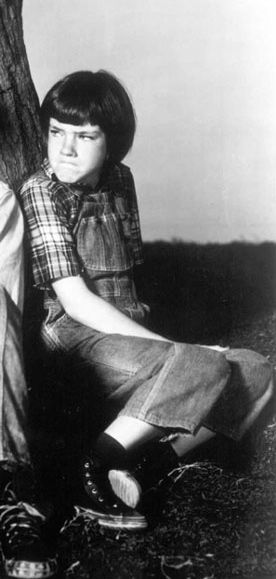
Sometimes it’s because the language is poetic. In To Kill a Mockingbird, when Scout Finch’s aunt comes to stay, she tries to turn Scout into a little lady. Scout explains her situation thus: “I felt the starched walls of a pink cotton penitentiary closing in on me.” As a lifelong tomboy, this sentence speaks to me loud and clear.

Other times I’ll remember a passage that made me think about the universe in a new way. At one point in my life, my favorite book was Harriet the Spy by Louise Fitzhugh. I’ll never forget the nanny, Old Golly, proclaiming “There are as many ways to live as there are people in the world.”

A few years later I discovered Ursula K. Le Guin’s The Left Hand of Darkness, a book that remains on my favorites list to this day. It not only shook up my thinking on gender, but also on political boundaries, when one of the characters asks a not-so-simple question:
“How does one hate a country, or love one? Tibe talks about it; I lack the trick of it. I know people, I know towns, farms, hills and rivers and rocks, I know how the sun at sunset in autumn falls on the side of a certain plowland in the hills; but what is the sense of giving a boundary to all that, of giving it a name and ceasing to love where the name ceases to apply?”

Finally, I have to admit I’m a sucker for scenes where a character quotes Shakespeare and pulls it off. I like this especially when it comes from an Average Joe type character, such Barnaby Gaitlin in Patchwork Planet by Ann Tyler. Barnaby goes through a bit of character development during the course of the story. Without giving spoilers for anyone who hasn’t read the book, there’s a scene where he recalls one poem he learned in school that he understood, a Shakespearean sonnet. He turns to another character, saying “Haply I think on thee.” You’d never predict the words coming from his mouth early in the book, but it so works by the time he says it.

Yeah, novels are long and there are big things in them: plots, story arcs and so on. But attention to detail is still important. Paying attention to getting the right words in the right order at the right place. It matters.

Poem of the Day, April 5

So far, I’m meeting my goal of writing a poem a day. Okay, I haven’t put any words down yet today, but they’re percolating. I’ll have them written before bed.

Here’s yesterday’s poem.  It’ll likely be rewritten a few times.


Geography by Disaster

Fukushima, Chernobyl
Geography learned by disaster
I look at an atlas
When people die
When buildings collapse
When leaders shoot their citizens
In the streets
When the fallout might land here

In tonight’s news I’d like to hear
About a place where today
Tulips bloomed
Fish swam in clean water
Families hiked
Women and men went to jobs
While children learned math
And have this continuation
Of life be amazement enough
To capture my attention


National Poetry Month

I’m happy to see another National Poetry Month roll around. I have been neglecting my writing, and especially my poetry for a while now. We’ve had an unusual amount of snow this year, resulting in many days out of school for my kids and lots of time spent on stuff like shoveling and sledding. I can’t say I regret the sledding, even if it was in lieu of writing. Also, I’ve been working more hours on my day job.

But now: National Poetry Month. Having an officially named month gives me a kick to do something. Ignoring those who say April is for Script Frenzy, my goal is a poem a day. I managed it last year. So far, I’m on track for this year, having written an actual sonnet today.

Here’s one of my favorite quotes about poetry:  “I was reading the dictionary.  I thought it was a poem about everything.” – Steven Wright

A Tale of Two Classrooms.

It was the best of educational experiences. It was the worst of educational experiences. It was a time in which a student could get an A on her English assignment for writing her “how-to” paper on the subject of How to Begin Your Secret Mission. It was a time in which a student could get no credit at all for writing a paper in World History with the assigned topic of “Ancient Greek Mythology” because she went beyond the rubric when she explored the sociological aspects and explained why the myths made sense in the context of the culture, when they can seem so nonsensical today. It was a time in which English teachers were lauded and World History teachers reviled within certain households. Creativity was nurtured and creativity was punished; individuality was encouraged and rigid conformity was enforced. Students were going directly on to brilliant college success because of their abilities to stretch their minds; students were headed to a life selling items that fell off of trucks because of their inabilities to follow directions to the letter. It was an American girl’s sophomore year in high school. The two classrooms were in the same building, but may as well have been on different planets.

Does any of this sound familiar? If you have a child in public school, I’ll bet it does. If there’s one thing I’ve learned from seeing my kids go through the school system, it’s that the administration can be good, bad or indifferent, and so can the curriculum. But it’s the classroom teacher who makes the most difference between a good educational experience and a bad one. If you’ve had a good teacher, remember to thank him or her.

Those are my thoughts for today.

To Do Lists

I was sorting through some of my poems, and came across this one I wrote in 2006.

To Do Lists

To be done before vacation:
Catch up all laundry
Make sure the grass is cut
And the bills are paid
Clean out the van

Upon returning:
Write a novel
Land a book contract
Transform my chronically messy house
into an aesthetically inviting
gathering place for the group of very hip
writers of which I will be a central figure
But first:
Clean out the van
Do the laundry
Pay the bills
And mow the yard

**

I’m still working my way through the line items. But I can check mark “write a novel.” And I’m making efforts at some of the others. Some photo evidence from the past year:


I still have a distance to go, however. One step at a time.


People Do Still Read

Despite the predictions made ever since the advent of television, my observation is that people do still read books. I work in a library, so I’m in a position to see this. Our circulation numbers go up every year. Okay, part of those stats come from dvd check-outs. But our book circulation is going up, too.

One thing I’ve noticed is that movies don’t necessarily supplant books. It’s not an either/or question, whether to see the movie or read the book. A lot of people do both. With the recent release of the movie, True Grit, our library suddenly has a waiting list for the book. The same thing happened with Shutter Island. When Harry Potter and the Deathly Hallows, P1 showed up in theaters, we were left with a couple of nearly empty shelves in the “R” area of children’s fiction, as patrons were interested in all of the books in the series.

My anecdotal evidence suggests we are not living in a post-literate society and are not going to be any time soon.

And the Winners Were…

2010 Award Books

A lot of awarding went on in 2010. The following is a by-no-means-comprehensive list of prize winners.

Anthony Awards (Mystery)

Novel:  The Brutal Telling by Louise Penny

First Novel:  A Bad Day for Sorry by Sophie Littlefield

Paperback Original:  Starvation Lake by Bryan Gruley

Caldecott Medal (Illustration in Children’s Books)

The Lion and the Mouse illustrated and written by Jerry Pinkney

Coretta Scott King Awards (Children’s)

Author:  A Bad Day for Outlaws: The Remarkable Life of Bass Reeves, Deputy U.S. Marshall by Vaunda Micheaux Nelson; illustrated by R. Gregory Christie

Illustrator:  My People illustrated by Charles R. Smith, Jr., written by Langston Hughes

Hugo Awards (Science Fiction)

Novel: The City & The City by China Mieville, and (tie)
The Windup Girl by Paolo Bacigalupi

Novella:  Palimpsest by Charles Stross

There are a lot more categories. Check them out.

Lambda Literary Awards (LGBT)

Children’s/Young Adult:  Sprout by Dale Peck

Nonfiction:  The Greeks and Greek Love by James Davidson

Many, many more categories. Please check web site.

The Mann Booker Prize (Fiction)

The Finkler Question by Howard Jacobson

Michael L. Printz Award (Young Adult Literature)

Going Bovine by Libba Bray

National Book Awards

Fiction:  Lord of Misrule by Jaimy Gordon

Nonfiction:  Just Kids by Patti Smith (editorial comment: YAY!)

Poetry:  Lighthead by Terrance Hayes

Young People’s Literature: Mockingbird by Kathryn Erskine

National Outdoor Book Awards

Nature and the Environment:  Adventures Among Ants: A Global Safari With a Cast of Trillions by Mark W. Moffett

Natural History Literature:  An Entirely Synthetic Fish: How Rainbow Trout Beguiled America and Overran the World by Anders Halverson
&  The Sound of a Wild Snail Eating by Elisabeth Tova Bailey

Children’s:  Camping With the President by Ginger Wadsworth; illustrated by Karen Dugan

They have more categories. Click the link above to see.

Newbery Medal (Children’s Literature)

When You Reach Me by Rebecca Stead

PEN/Faulkner Awards (Fiction)

War Dances by Sherman Alexie

Pulitzer Prize

Fiction:  Tinkers by Paul Harding

History: Lords of Finance: The Bankers Who Broke the World by Liaquat Ahamed

Biography:  The First Tycoon: The Epic Life of Cornelius Vanderbilt by T.J. Stiles

Poetry:  Versed by Rae Armantrout

Pura Belpre Awards (Latina/Latino author/illustrator)

Author:  Return to Sender by Julia Alvarez

Illustrator:  Fiesta!: Celebrate Children’s Day/Book Day; Celebremos El día de los niños/El día de los libros , illustrated by Rafael López, written by Pat Mora

RITA Awards (Romance)

Young Adult Romance:  Perfect Chemistry by Simone Elkeles

Inspirational Romance:  The Inheritance by Tamera Alexander

Novel with Strong Romantic Elements: The Lost Recipe for Happiness by Barbara O’Neal

Historical Romance:  Not Quite a Husband by Sherry Thomas

First Book:  One Scream Away by Kate Brady

There are even more categories. Check out the website, linked above.

Robert F. Sibert Informational Book Medal

Almost Astronauts: 13 Women Who Dared to Dream by Tanya Lee Stone

Toronto Book Awards

The Carnivore by Mark Sinnett

World Fantasy Awards

Novel:  The City & The City by China Mieville

Happy reading!


Bibliophile’s Ultimate Holiday Gift

Are you looking for the ultimate holiday gift for the bibliophile in your life? How about…

http://www.dbrl.org/files/RFP-2010-12-bookmobile.pdf

Wouldn’t it be cool to own a bookmobile? I believe in some alternate universe, I do own one. I travel the continent in it. I have a writing space set up in it. I drive from book signing to book signing, reading to reading. And I can sell my books right from the bookmobile, which incidentally sounds a lot like the Batmobile, something that makes it even cooler.

Sadly, I feel the need to tack a cautionary note here: Please don’t anyone think it would be cute to contact the seller if you aren’t serious about buying. The intention of this post isn’t to create harassment for anyone.

Rejection Letter

A friend just had her novel accepted for publication after 30 rejections. Thus, I’m inspired to try at least 31 publishers, if need be, before giving up. Two down. I feel moved to share the more recent rejection letter of the two. I don’t know why, but expect it to happen again. Maybe as an experiment in how many different ways rejection can be phrased.

So here it is, hot off the email:

Dear Author,

“My partners here at Pointless Pothole Press* have looked at your proposal for the novel _ _and we have decided not to ask to see more of the MS. There is no particular reason, and we agree that your idea is interesting. We are a small press, and we need to keep the number of MSS we look at manageable. We are currently considering a number of other proposals.Thank you for considering Pointless Pothole Press.”

Two things strike me. The first is the phrase “There is no particular reason.” Uh….whuh? The second is the way he can’t bring himself to write out the word manuscript. It reminds of me of my grandma always calling toilet paper “TP.”  Sort of like a manuscript is something necessary, but you don’t discuss it in polite company.

On to number three.

*Not the real name of the publisher.

Support Your Local Writer

I know a lot of folks who appreciate the arts and would love to show support, but who don’t have a boatload of money for extras. Some of them don’t even have a thimbleful of money for extras. For those in this situation, let me offer some tips on how you can help out writers you know and/or admire.

If you have some money to spend on books, but not much, prioritize. Choose to spend your book money only on publications by local writers, or only on publications by writers you know personally, or choose one writer you can feel really good about supporting and buy her/his books new. Fill the rest of your reading list at the public library, or buy used. I manage to budget enough money to buy about half a dozen books a year new. Most of these are written buy people I know, some of them self-published. I also buy all of the Dresden Files books by Jim Butcher. He’s localish, living in the same state, and he came to speak to my writing group once before he made it to The New York Times bestseller list. He seemed like a genuinely nice guy who wanted to help other writers. And I like the books.

If you have no book money in your budget, you can still help a writer in need by checking out her/his book from the library. The more a book is checked out, the more copies get ordered, and the more likely it is to be replaced if lost or damaged. If you can’t find the book in your library, ask about placing a request to purchase. Public libraries encourage patrons to communicate about what books they want. If the selector knows a book will be read, he/she is likely to buy it.

If the writer you want to help out is someone near and dear, and you don’t mind going above and beyond, there are even more actions you can take. Call your nearest bookstore and ask if they have the title, even if you don’t plan to purchase it. That way you’re helping raise public awareness about the existence of the book. If the bookstore employee asks whether you’d like to place a special order, you can always say “Not right now. I’ll check a couple of other places first.” If the bookstore does have the title, and you have time to kill, you can go in and browse, incidentally leaving the volume prominently displayed when you’re done skimming it.

And once you’ve done all of these things, don’t feel bad about reminding that certain special writer in your life about the purpose of the acknowledgments page. You might get in a mention in the next book.