
A few weeks ago, our neighborhood hosted a day of garage sales, and these two curiosities made their way home with me–tour itineraries for England, Wales, and Contintental Europe, for the years 1913 and 1914.
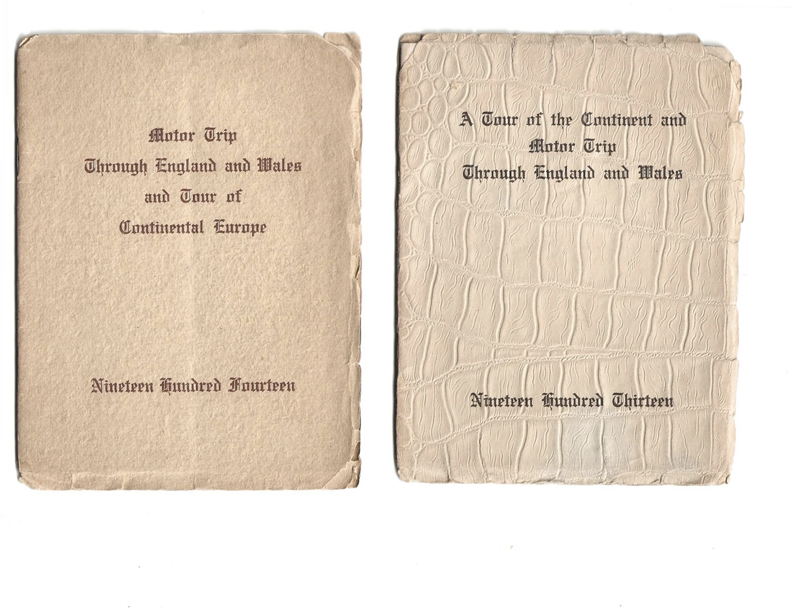
I assume all went well in 1913, since the tour organizer, Ms. Stella M. Weyer of Washington, PA, decided a repeat was in order for the next year. Perhaps she had begun what she believed would be a years-long career. Who knows?
Looks like a fascinating travel plan:
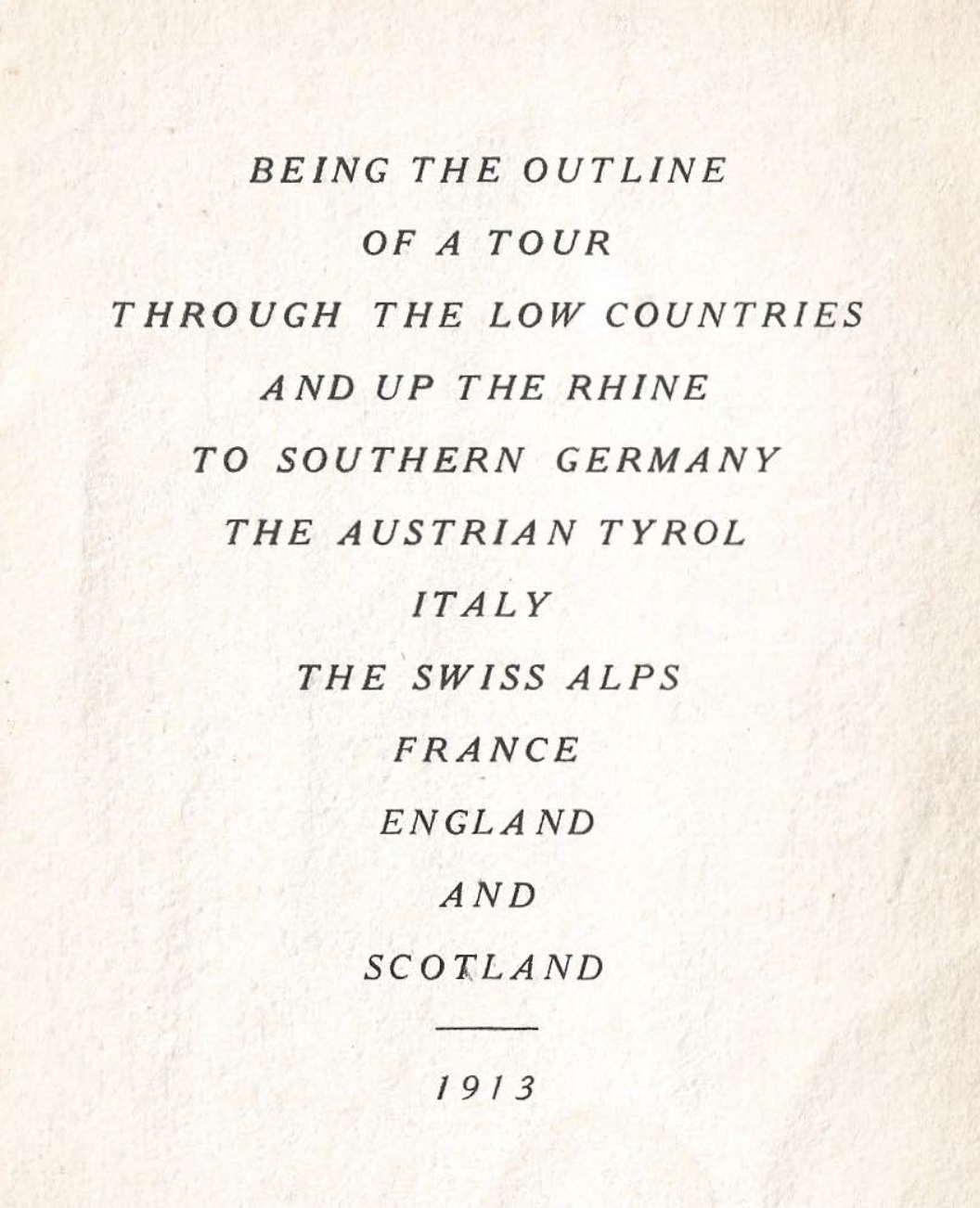
As an added item of interest, when I opened the 1913 booklet, a packer’s voucher from Phoenix Knitting Works fell out. It was dated 6/4/13. I guess someone mail ordered a scarf or something to wear on their sojourn.

Some of the tour notes telling travelers what to anticipate are a delight to read from a 2025 perspective. “Our motor cars are procured of the best London firm, are high-grade machines…driven by expert chauffeurs. The average rate of speed will approach twenty miles an hour…”
That’s 1913.
Looking at the 1914 itinerary evokes a whole different set of feelings.
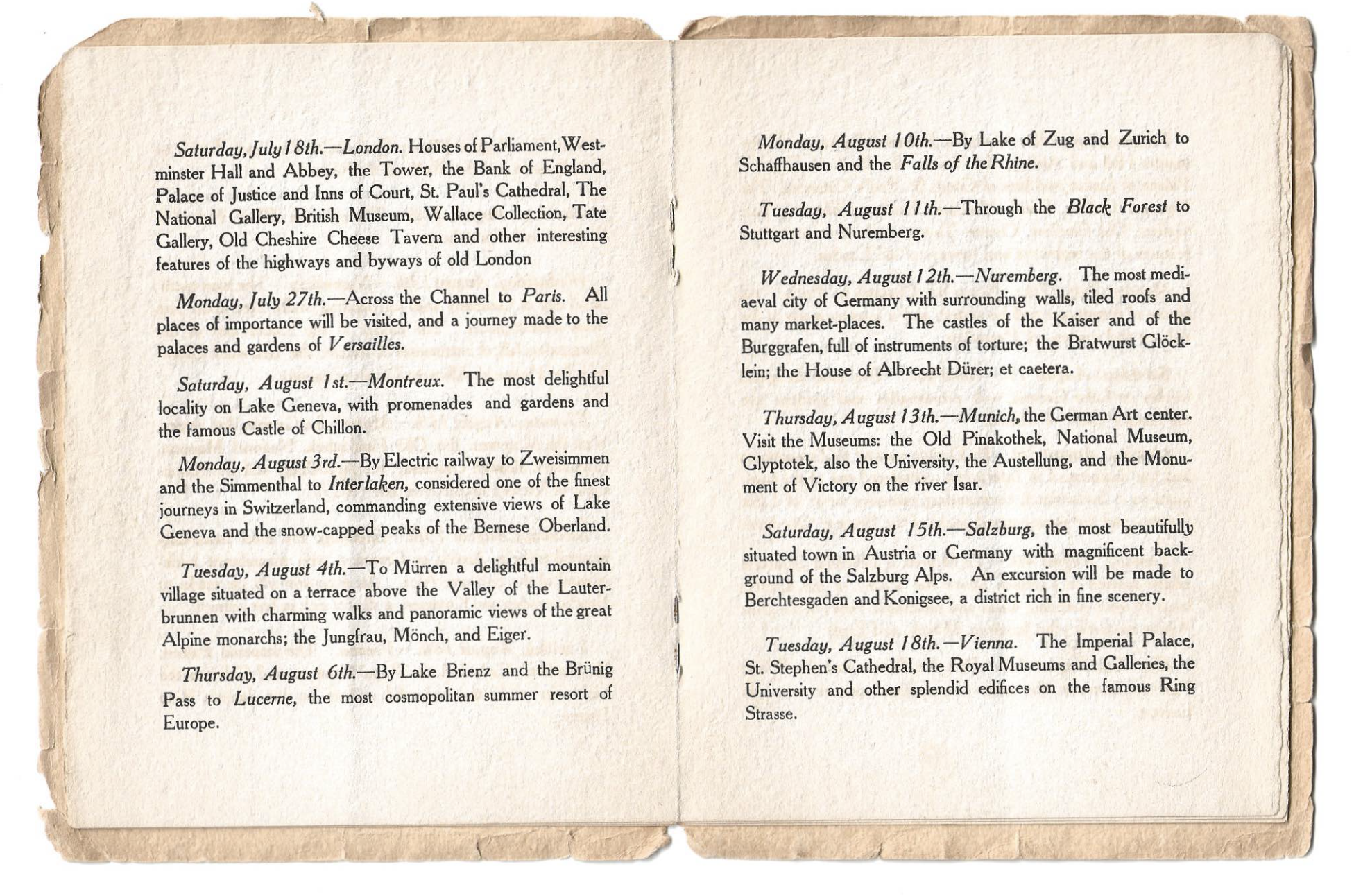
The journey was set to begin from New York on July 2, and I’m burning with curiosity to know how far the group actually made it into the trip. Did they even embark after learning of the assassination of Archduke Franz Ferdinand a few days earlier? Or were they unaware of the direction things were heading, and figured it would blow over?
July 27th has them arriving in Paris, the day before Austria-Hungary declared war on Serbia, the official beginning of World War I. Their plan for mid-August was to visit Germany and Austria. By that time, several countries had been drawn into the fight, including France, Britain, Luxembourg, Belgium and Russia.
Imagine being in the middle of what was to be your vacation of a lifetime only to find yourself witnessing the commencement of the bloodiest, most widespread war the world has ever seen. How do you get the universe to laugh? Make a plan.
I have gone down some rabbit holes trying to find any other information about these tours, specifically the fate of the 1914 venture. But no luck. I have however, learned a bit about Stella Marshall Weyer, the organizer listed in both pamphlets.
She was born in 1876 in Portsmouth, Ohio. So she would have been in her mid to late thirties when all this was going down. And she lived in St. Louis for a portion of her life, which could be related to why I found her travel plans kicking around in central Missouri more than a century later, though she never married or had children as far as I could find.
A St. Louis Post-Dispatch article from 1893 lists Stella as a new graduate of Hosmer Hall, an all-girls’ school. An 1896 society article says she’s traveling to Leipzig to visit her brother and study art. Aha! She was experienced in European travel from a relatively young age. (Sorry, these are behind a pay-walled database through my local library, so I can’t link to them.)
Most significantly, I discovered she volunteered as a Red Cross canteen worker in France during the war, returning to the U.S. in 1919, after the Armistice of November 11, 1918. It’s possible her group was in France at the outbreak of hostilities, and she just stayed there, helping. She only lived a few more years, dying in 1923 of glioma of the brain.
In the past few years, we have seen for ourselves what it’s like to live inside of history. I know I’m still reeling from the world changing virtually overnight when the pandemic hit in 2020. But coming across these artifacts and learning a little about one single person who was caught in the maelstrom of world events has added a new layer of introspection.
Maybe what I’m learning is that we, in our current time and our place, just aren’t special. We’re not exempt. Anyone anywhere can find themselves in the middle of some kind of troubles. Our choice is whether and how to do some good anyway. Stella Marshall Weyer appears to have risen to an astounding occasion and volunteered in a way that was available to her. I’m going to keep that in mind this Armistice Day/Veterans’ Day.
~~

 Nomadic Noesis