You Have the Right to Request a Channel Change

Trigger warnings: violent crime.

Yesterday I was sitting in a waiting room while my son had some medical scans done. I always have a book handy for such occasions, but it was a little hard to enjoy it while the wall-mounted television blared at loud volume with some police drama involving the search for a child rapist/murderer.

black crt tv
Photo by Huỳnh Đạt on Pexels.com

Several other people were in the waiting room as well, including a couple of families with young children. I saw one pregnant mom and her partner trying to keep their kids distracted, as they moved to the far side of the room from the TV. Unfortunately, the show was audible from all corners. I could tell the program was disturbing them at least as much as it was me. I remember those pregnancy hormones and the instant overwhelming grief I would feel upon hearing of any harm to a child.  Then, too, who wants their kids to hear discussions of children being horrifically murdered?

After the fourth mention or so from the TV characters about raped and murdered children, I went to the reception desk and asked if there was a way to change the channel. I think the woman working there had been focused on her work and managed to tune out the show. She looked up at the screen after I asked and seemed to realize then what was playing. She handed me a remote, saying, “Of course. Put it on whatever station you want.”

As I turned around with the remote in my hand, the pregnant mom looked me in the eye and offered the most sincere “thank you” I’ve ever heard. I’ve never had cable television, so I don’t even know about channels. “Is there a channel your family likes?” I asked her.

She shook her head. “It doesn’t matter. Anything but that.”

I flipped through a few, trying to find something non-controversial and non-traumatic. I settled on college baseball. After I returned the remote and sat back down, an older man near me thanked me as well.

Here’s the thing. I’m shy. I carry a lot of social anxiety around with me. But of everyone who wanted the channel changed, I was the only one who felt empowered to do something about it. I guess?

If you like police procedurals and want to watch whatever that show was at home, I’m not judging. I, too, sometimes enjoy shows where I feel like an evil doer is brought to justice. But it was so obviously inappropriate for the situation and so obviously distressing a number of people.

Let me give a little pep talk here. It’s not overstepping to say that something is distressing and politely request a remedy. You don’t have to sit there thinking it’s terrible but you just have to live with it. Folks, you have the right to request a channel change.

Shakespeare’s Henry IV, a Tale for Modern Times

photo of black ceramic male profile statue under grey sky during daytime
Photo by Mikes Photos on Pexels.com

A few weeks ago the universe gifted me something I’ve wanted for a long time — the Complete Works of William Shakespeare, in two volumes. I’m pretty sure I’ve read all of his freestanding poems over the years. But I must admit to familiarity with only a small handful of his plays. I decided to make a project of reading and then watching all of the plays, which I can do thanks to my public library’s DVD collection.

So, let’s talk about Henry IV, parts 1 and 2, and how the more things change, the more they stay the same. Though the story follows conflicts between royalty rather than elected officials, many elements seemed all too familiar to me, with parallels to current events. I suppose this is why Shakespeare’s works endure. He captures the universals of the human experience.

King Henry IV, in his efforts to have things 100% his way, ends up stoking rebellion instead. He is free with insults for those who incur his displeasure. Transactional behaviors and relationships abound — characters all trying to use each other. See what I mean? Sound familiar? Throughout the two plays, alliances shift among several factions, and nobody knows whom to trust. Covert help is sought from foreign sources. Each side has its mix of hot-heads (one even nicknamed Hotspur), schemers, sincere believers, and rascals.

This even holds true within the King’s own immediate family. Prince Hal spends his time getting into trouble with a group of wastrels, deliberately keeping expectations for himself low so he can easily exceed them. Meanwhile his younger brother, John (a character who might strike a chord if you’ve ever known an adult child of an alcoholic) just wants to make all of his kin happy through his hard work and rule following.

The Earl of Worcester foreshadows Fox News as a source of disinformation to gin up the case for war for his own purposes. The spirit of Falstaff lives on today in profiteers who seek their own fortunes and comfort above duties to others. Treachery and double dealing are rampant throughout the course of the two plays.

At the very end of part 2, Prince Hal ascends the throne as King Henry V. And suddenly his scandalous former associates are disavowed as no more than coffee boys he only met a time or two. He doesn’t really even know them. (Sorry if that was a spoiler for anyone.)

I guess there are patterns to human affairs.

Notable quote:
Pride defeats its own end, by bringing the man who seeks esteem and reverence into contempt.

On Today’s Walk 12-9-18

On today’s walk, it was sunny but brrr c-c-c-old. On the one-mile lap around my immediate neighborhood, I engaged in not a single spoken conversation. Yet a fair amount of communication happened.

IMG_4129


I ignored the caution sign and went close to peek under the rock, because I’m a rebel without a clue. All I saw was a hole in the ground.

On Today’s Walk 11-24-18

I strolled my neighborhood in unseasonably temperate weather, perfect for a walk — the last few warm hours before a predicted winter storm.

I heard leaf blowers, but never saw them. I saw people raking the brown, drying remnants of autumn, and running them over with mulching mowers. I saw a family taking photos of their toddlers playing in a leaf pile. At one house, a determined man used a front-loading Bobcat to push the masses of leaves from his lawn into one big stack near the edge.

Maybe I should have been have been doing yard work instead of playing tourist to all of the neighbors doing theirs. I still have undone weeding, left over from the summer. On the other hand, the mess of my yard might not be visible under the snow by this time tomorrow.

The bodies of the leaves are gone, but their spirits have not yet crossed over:


On Today’s Walk, 11-16-18

I walk a fair amount. I usually commute to work on foot. I also walk recreationally. It occurred to me to share what I encountered. I know I’m not winning any awards with my photos. I’m as amateur as they come. But here’s life as I see it.

On today’s walk, carpets of leaves:

This slideshow requires JavaScript.

My own elongated shadow:

IMG_4030

A large deer in someone’s yard. Some kids off-camera called to him, “Here Bucky. Bucky, Bucky.” Until he turned to face them. Then one of them yelled, “Run, before he stabs us with his horns!” Spoiler: there was no horn stabbing.


I perambulated 1.75 miles, just around the neighborhood.


Armistice Day Resolution

calm daylight evening grass
Photo by Pixabay on Pexels.com

Interesting fact: you don’t have wait for New Year’s Day to start working on a goal. This November 11 marks the 100th anniversary of the Armistice that silenced the guns of World War I, or the Great War as it was called at the time. It had been one of the largest and bloodiest conflicts in the history of humankind, resulting in millions of deaths and immeasurable pain and suffering.

By the time it ended, the world was hungry for peace. It was supposed to be the “war to end all wars” yet many of the wars that have followed had roots in that conflict. It turns out peace isn’t something you get once, set on a shelf to admire and there it stays forever. Peace requires an active, sustained effort, always. We will never have to stop working for it.

Robert F. Kennedy said, “Each time a man(sic) stands up for an ideal, or acts to improve the lot of others, or strikes out against injustice, he sends forth a tiny ripple of hope, and crossing each other from a million different centers of energy and daring, those ripples build a current that can sweep down the mightiest walls of oppression and resistance.”

And Desmond Tutu has said, “Do your little bit of good where you are; it’s those little bits of good put together that overwhelm the world.”

So my Armistice Day resolution is to do my little bit, starting with internal work, to create a ripple. To actively look for little bits of good I can do where I am each day.

A friend of mine recently passed away after a six-year struggle with cancer. She was truly a light in the world — one of those individuals who inspires the best in others. After the last presidential election, when many of us were on social media discussing what we could do, or what we would do to try to save the world, she posted that she was in the middle of chemo treatments and much too weak to go to meetings or phone bank or march. But she would spend some time each day on loving kindness meditations. That was her ripple.

I have decided, though it won’t be the whole of my action, I will try to help that ripple spread by focusing on the same thing as my main goal. My first concrete step is peace within myself, so I can then work on the world. In that spirit, and to honor my friend’s memory, I have the goal to engage in a loving kindness meditation at least four mornings a week. From there, my actions can build.

A Word About Redemption Stories

I love a redemption story as much as anyone. But there are certain necessary elements — remorse, concern for people who may have been hurt, an attempt to make amends, a change in behavior going forward. If those pieces are missing, it’s not a redemption arc. It’s a story of a stunted character trying to shirk responsibility.

Patricia Highsmith is the only author that immediately comes to mind who successfully made a character like this the main focus of her stories. Usually, a character of this nature would have a starring role only as an antagonist to the hero. And if said character gains power, that’s not evidence of redemption. That’s just upping the stakes.

Yes, these thoughts were prompted by current events.


Meditative Librarian

pile of books
Photo by Pixabay on Pexels.com

I saw a job listing for a meditative librarian. But on second read it was metadata librarian.

Nonetheless, now that the position of meditative librarian has been created, even if only in my own mind, I aim to fill it. I will be your meditative librarian. Let’s begin.

Find a comfortable position, in a meditation hammock perhaps.

Feel the weight of the book in your hands. Allow the pages to open naturally.

Breathe in the new book or old book smell.

Feel the weight of the words in your soul.

If reading leads to thoughts, no matter. Let those thoughts occur naturally with no resistance. When you notice them, simply turn your attention back to your reading.

Feelings may arise. Allow them to be.

Let yourself sink into the words on the page. Feel the connection to the world created therein. Hold the characters in your mind. May they be happy. May they be healthy. May they overcome the story’s conflicts.

You are as one with the other readers who have inhabited this same world. All are interconnected.

Allow yourself to continue to read, not trying to control or direct your emotional responses.

Breathe in, rising action. Breathe out, denouement.

When you are ready, end the reading meditation gradually. Close the covers slowly. Take a few cleansing breaths. Stretch and allow your gaze once again to take in your surroundings.

Remember that a regular reading practice contributes to health and well-being. Set aside a time every day if possible.

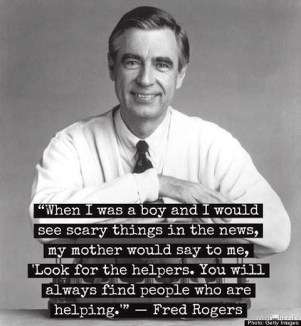
Won’t You Be My Neighbor?: Thinking About Fred Rogers

Mister Rogers
Credit: Daren McClure, flickr

We didn’t have a television when my kids were little. We occasionally popped a DVD into the computer for them, but TV as such didn’t come into their lives until they were out of grade school. The only thing I’m sorry they missed was Mister Rogers’ Neighborhood. we did read some of his books and we owned a cassette tape of his songs that they listened to again and again. So he still influenced their lives.

These days I work in a public library. Fifteen years after Fred Rogers passed away, parents are still coming in looking for his books to help their children through difficult issues. One mom recently said to me, “My first thought when I was trying to figure out how to help my son (through a loss) was, there has a be a Mister Rogers book we can find.”

Over the weekend I went with my husband and 20-year-old son to see Won’t You Be My Neighbor? — the documentary about Fred Rogers. My husband might have made it through with dry eyes. Maybe. Neither my son nor I did.

Spoiler: Was Mister Rogers really like that? According to everyone interviewed in the movie, yes, absolutely. The movie didn’t paint Fred Rogers as perfect and all-knowing. It showed how he had some growing to do through the years on some issues and that he struggled with self-doubt. He was human, but a pretty gosh-darned exemplary human.

The truly great thing about Mister Rogers was that he didn’t lie to children. He took on tough, tough subjects and let kids have their feelings about them. He never pretended children’s lives were easy. He never said, don’t be scared or don’t be angry. The vital part of his message lay in telling children those feelings are to be expected sometimes, but that there are healthy ways to express them and that you will survive having them. He also deconstructed gender stereotypes by showing that a man could be a gentle, patient, nurturer.

My newly grown son was a child who needed gentle, patient, listening adults in his life. After the movie, he seemed profoundly moved. All he could say at first was, “He really understood children and what they need.” Later we talked some more about the bigger philosophy of Mister Rogers and his message of unconditional love.

Go see the movie if you can at all. It’s a needed reminder in these dark times that there are people who strive for goodness and kindness, people who dedicate their lives to making the world better. It’s also a good reminder that heroism comes in many forms, including quiet small acts such as inviting someone of another race to soak his feet in your pool at a time when public pools were segregated.

I came away inspired to be my best self. I will try to be the person Mister Rogers believed I could be. And I will remember that even he had self-doubt, but he kept working anyway.